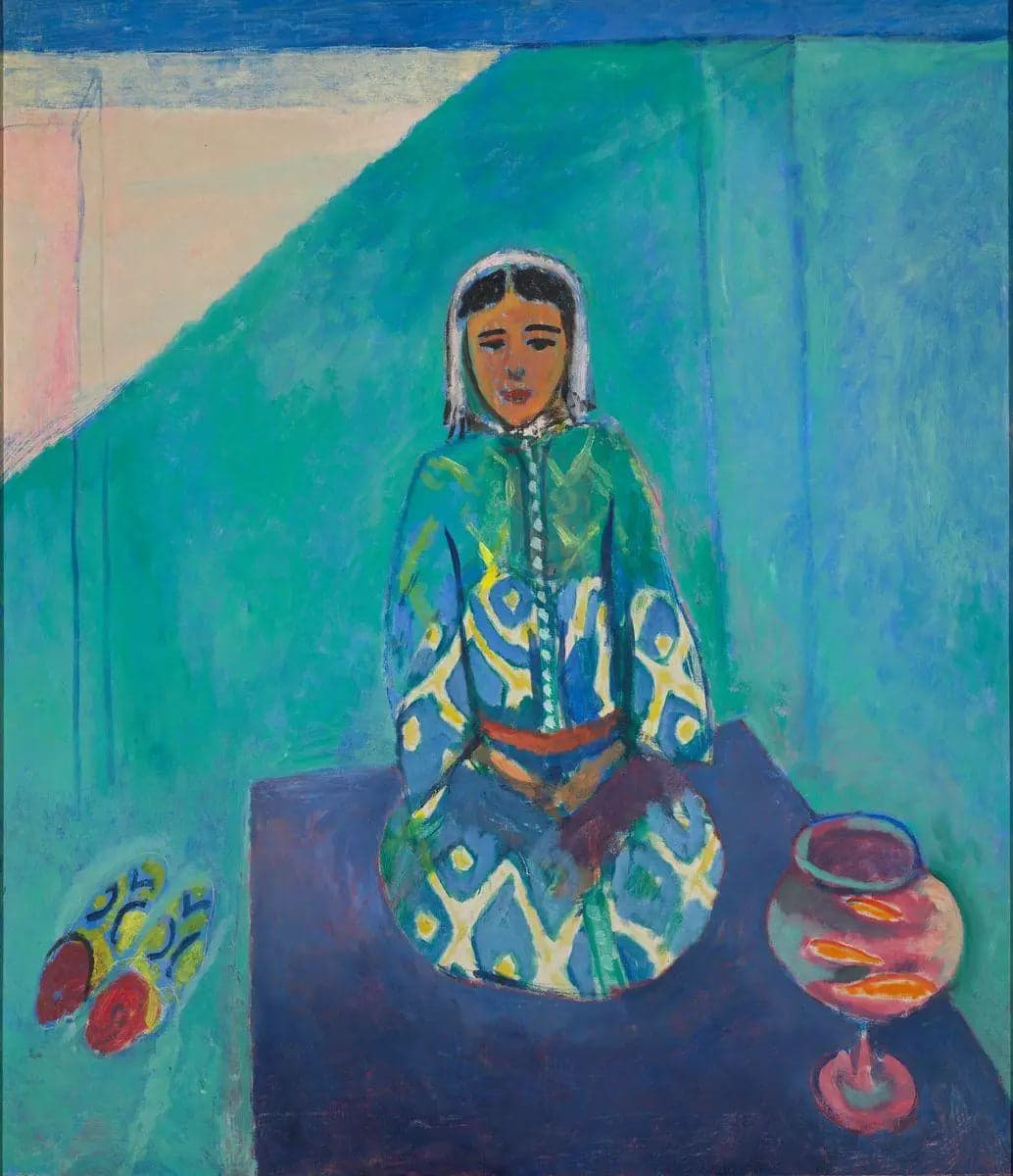
Zorah on the Terrace
- Original dimensions
- 100 x 115 cm
- Museum
- Pushkin Museum of Fine Arts
- Year
- 1912
Scene depicted
The painting "Zorah on the terrace" depicts a woman sitting peacefully, wrapped in a dress of vibrant hues, on a terrace offering a splendid view. The swirling forms, the colorful juxtaposition of elements, as well as the bright light reveal the gentle tranquility that reigns in this scene. Matisse uses expressive lines and sumptuous colors, offering a glimpse of pure beauty and the intimacy of this moment frozen in time.
Historical context
Created in 1912, in the bubbling context of the artistic avant-garde in Paris, the painting "Zorah on the terrace" is part of the Fauvist movement, of which Henri Matisse is one of the masters. This iconic work, now preserved at the Pushkin Museum of Fine Arts in Moscow, captures the essence of a bold era, marked by freedom of expression and chromatic experimentation. With its generous dimensions, the canvas offers a sensory immersion into a vibrant world of colors.
Place in the artist's career
"Zorah on the terrace" marks a turning point in Matisse's career, symbolizing his shift towards a deeper exploration of color and composition. Compared to his earlier works, such as "Woman with a Hat" and his later works like "The Dance," this painting represents a moment of artistic maturity, where each brushstroke is a dialogue between color and emotion.
Anecdote
Henri Matisse often said: "Color is the tool with which I pass emotions." His encounter with Zorah, his model, on a sunny afternoon, inspired this masterpiece . In the intimacy of his studio, bathed in the soft light from outside, Matisse sought to capture not only the silhouette but also the soul of a moment shared on the terrace. This canvas then becomes the voice of his emotions, the reflection of an authentic connection.