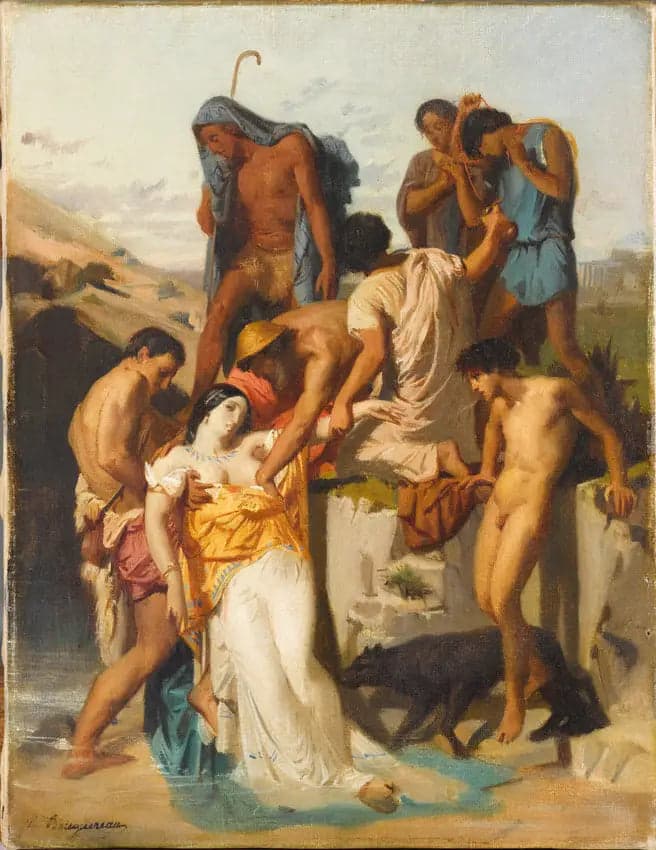
Zenobia Found by the Shepherds on the Banks of the Arax
- Original dimensions
- 24 x 32 cm
- Museum
- Orsay Museum
- Year
- 1850
Scene depicted
In this canvas , we discover Zenobia, the queen of Armenia, found lifeless by shepherds on the mystical shores of the Araxes. This moment of tenderness and mystery evokes the tragic fate of this historical figure, capturing the collective imagination. Bouguereau, as a true visual storyteller, breathes life into this scene, weaving a connection between pastoral innocence and the whispers of ancient legends.
Historical context
Created in 1850, the painting "Zenobia Found by Shepherds on the Banks of the Araxes" is part of the French artistic movement academic of the 19th century, which advocated beauty, realism , and harmony. This canvas is rooted in the tumultuous historical context of France at the time, a period of cultural and artistic redefinition. Currently, this iconic work resides in the prestigious halls of the Orsay Museum in Paris, where it presents itself with delicate dimensions of 24 x 32 cm, inviting viewers to explore it up close.
Place in the artist's career
"Zenobia Found by Shepherds on the Banks of the Araxes" represents a turning point in Bouguereau's career, marking his ascent to the heights of French academicism . Alongside other paintings such as "The Interior of a Cabaret" and "The Birth of Venus," a distinct evolution in his technique, his ability to evoke emotion, and to play with light can be observed, characteristics that would become his trademarks.
Anecdote
"Beauty must transcend the ordinary," said Bouguereau. A phrase he captured one spring morning, crossing the gaze of a young woman on the banks of the Araxes, a reminiscence of mythology, embodying sweetness and grace. This emotion, captured through his brush, powerfully expresses itself in this painting , where the heroism and purity of Zenobia flourish under the rays of enchanting light.