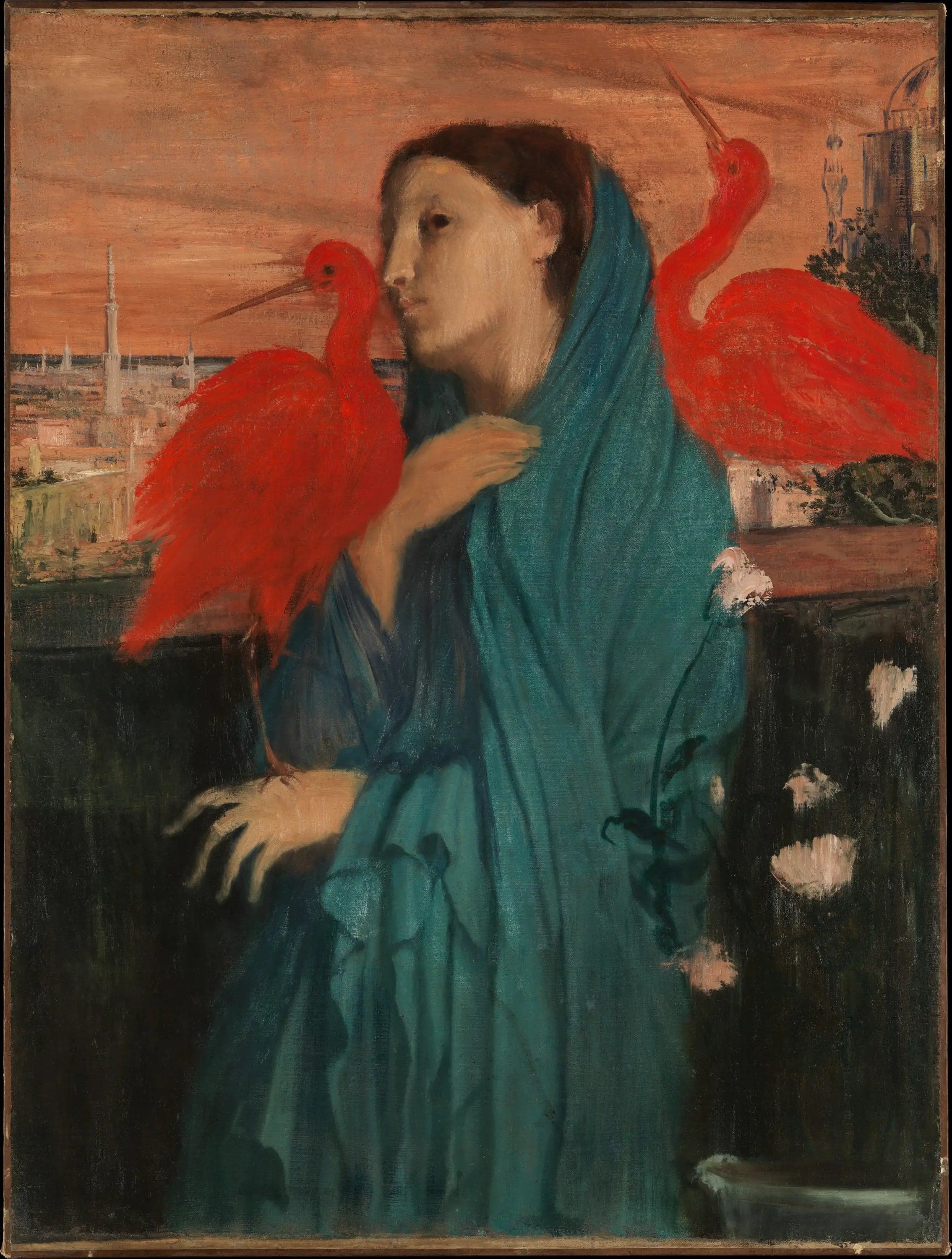
Young Woman with Ibis
- Original dimensions
- 74.9 x 100 cm
- Museum
- Metropolitan Museum of Art
- Year
- 1860
Scene depicted
The canvas depicts a delicate scene in which a young woman, dressed in a light dress, stands with infinite grace. Her gaze is lost on an ibis, a symbol of beauty and wild elegance, projecting an atmosphere that is both peaceful and mysterious. The composition wonderfully illustrates Degas's art, which knows how to capture fleeting moments of life.
Historical context
Created in 1860, during a period of great artistic effervescence in the city of Paris, this painting summarizes the Impressionist movement that is beginning to take shape, while remaining true to classical technique. The canvas is today preserved at the Metropolitan Museum of Art , a prestigious place that houses invaluable works from the history of art.
Place in the artist's career
The painting “Young Woman with Ibis” constitutes a significant milestone in the career of Edgar Degas , on the path of his stylistic evolution. Positioned between his promising beginnings and his period of maturity, it dialogues with works such as “The Dancer with Tambourine” and “The Ballet,” revealing his obsession with movement and women in art.
Anecdote
It is said that Edgar Degas , passionate about the representation of movement and daily life, found inspiration for this masterpiece one sunny morning, where he observed a young woman captivated by an ibis in a park. His words resonate: “Nature is a dance that we refine for eternity.” This quote illustrates the evocative power of the painting .