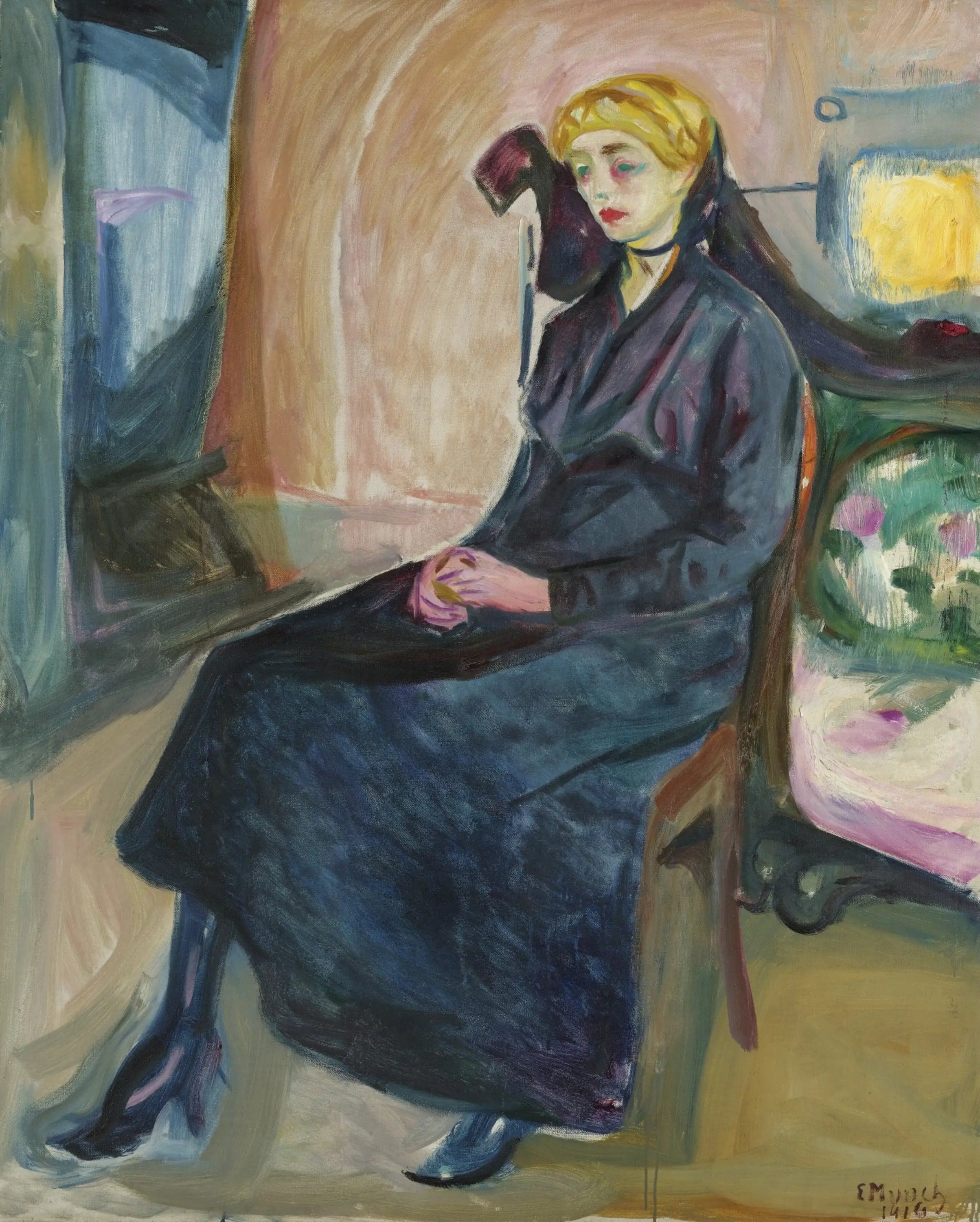
Young Woman Sitting
- Original dimensions
- 73 x 54.4 cm
- Museum
- Bergen Art Museum
- Year
- 1892
Scene depicted
This canvas illustrates a woman sitting, lost in her thoughts, seeming to drift into the void. The clean background allows the focus to be on her face and delicate posture, witnesses to a modest melancholy. Through the nuances of his painting , Munch captures the essence of isolation and introspection, elevating this pictorial work to the rank of an icon of modern psychology.
Historical context
Created in 1892, this painting is emblematic of an era marked by the symbolist movement, rooted in the city of Bergen, Norway. It is in the heart of this Scandinavian region, with its enchanting landscapes and harsh winters, that Edvard Munch develops his artistic vision. This masterpiece , currently housed in the Bergen Art Museum, embodies the delicacy and complexity of human emotions while grappling with the reality of a changing world. Its dimensions, 73 x 54.4 cm, evoke intimacy and the personal, placing each observer close to the very essence of the canvas.
Place in the artist's career
Young Woman Sitting represents a turning point in Munch's career, marking the beginning of a more intimate and personal exploration of humanity. While he is already asserting himself with compositions such as The Scream and The Madonna , this work fits into a period of maturity where the artist becomes a pioneer of symbolism , deepening his treatment of emotions.
Anecdote
“Painting is for me a way to release silence,” said Munch. One spring morning, while walking through a peaceful alley in Bergen, he meets the gaze of a young woman, the simplicity of her posture captivates his imagination. This fleeting moment, this reflection of humanity, becomes the source of inspiration for Young Woman Sitting , imbued with the emotional depth characteristic of the artist.