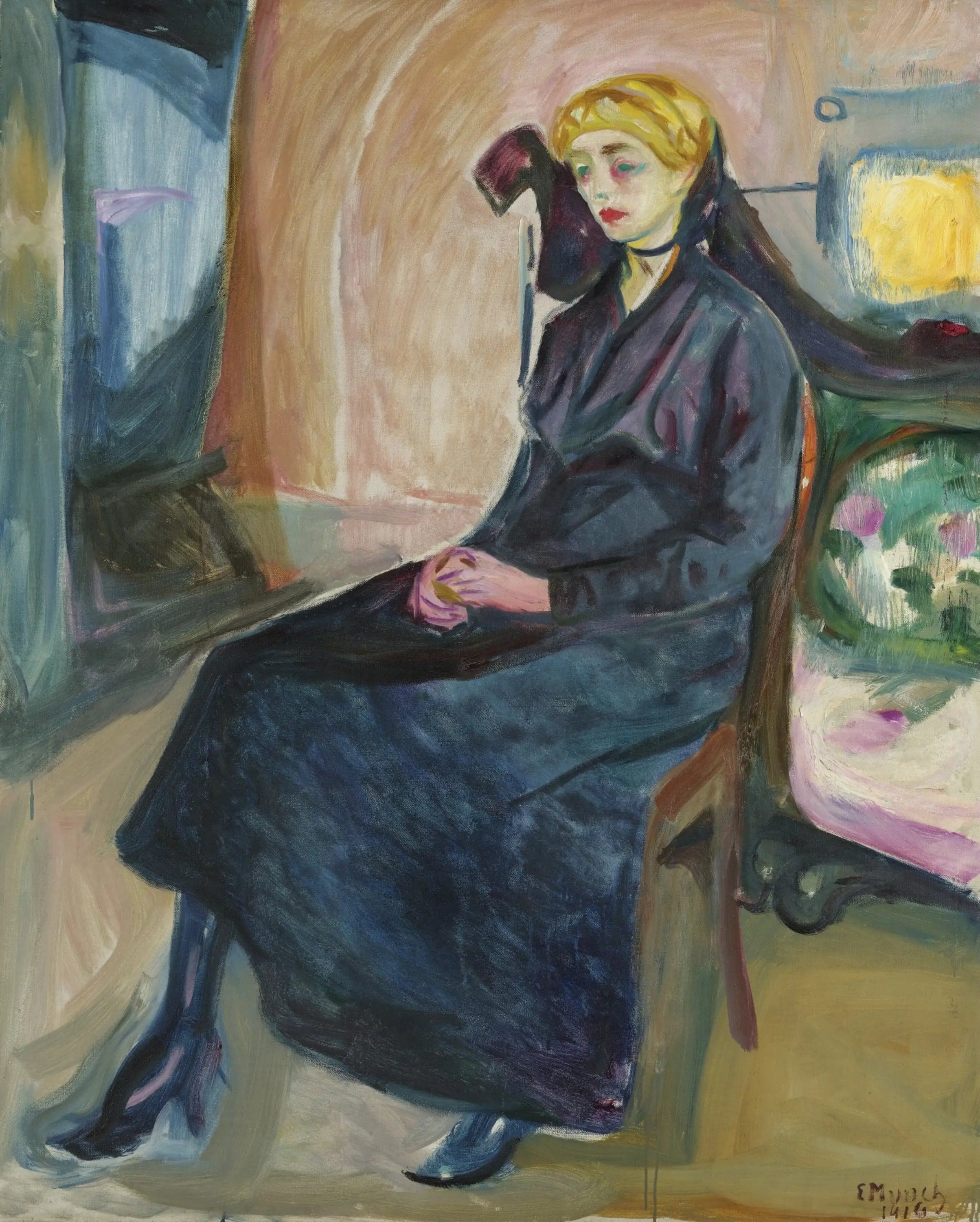
Young Woman Sitting
- Original dimensions
- 110 x 136 cm
- Museum
- "degenerate art" collection
- Year
- 1916
Scene depicted
In the composition of this masterpiece , Munch presents a young woman, immersed in her thoughts, dressed in a simple dress, exposing a palpable fragility. The psychological depth of the scene manifests through a pensive expression, harmoniously highlighted by colors that seem to vibrate with latent emotion. It is a canvas that speaks of internal struggles and the soul's battles, where the young woman becomes the symbol of universal introspection.
Historical context
The painting famous by Munch, created in 1916, is set against the tumultuous backdrop of Europe, then marked by World War I. In an artistic universe where expressionism emerges as a response to social and political tensions, this canvas asserts itself as a declaration of the intimate and solitude. Currently preserved in a collection that testifies to works classified as "degenerate art," this painting measuring 110 by 136 cm invites deep contemplation.
Place in the artist's career
This painting , from a creative period marked by a quest for psychological depth, naturally fits into the career of Edvard Munch . Situated between the famous paintings such as “The Scream” and “The Madonna,” it testifies to the artist's stylistic evolution, revealing his transition from frenetic expressiveness to a softer and more introspective contemplation. This canvas represents a turning point where tensions diminish in favor of a palpable emotional richness.
Anecdote
“The truth of a face is expressed in its silence,” Munch might have said as he sought inspiration. Imagine a soft morning, illuminated by amber light filtering through heavy curtains, revealing a feminine silhouette, imbued with melancholy. This fleeting moment infused an evocative strength into the painting that transcends the trivial to capture the very essence of existence.