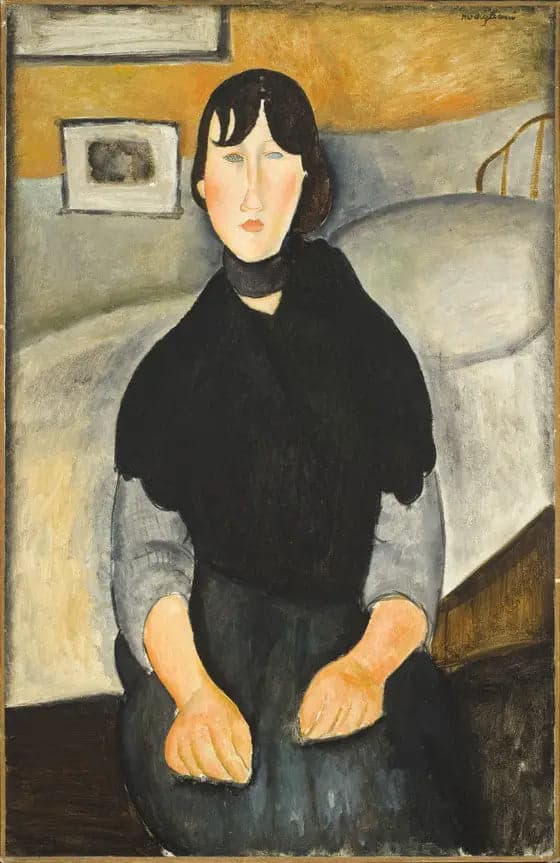
Young Woman of the People
- Original dimensions
- 64.1 x 89.5 cm
- Museum
- Los Angeles County Museum of Art
- Year
- 1918
Scene depicted
In this painting , Modigliani captures a moment of poignant finesse. The young woman, whose features are stylized and slender, embodies the spirit of the people. Her deep and melancholic gaze evokes stories of life, labor, and authentic beauty. Through his composition, the artist invites introspection, revealing the silent dignity of an ordinary existence underscored by an aristocratic allure.
Historical context
Created in 1918, this painting is set against the rich backdrop of the City of Light, Paris, then the epicenter of avant-garde artistic movements. Young Woman of the People , a symbol of Modigliani's stylistic maturation period, represents a pivotal moment in art history, linking Fauvism to modernity. Today, this work is housed in the Los Angeles County Museum of Art , maintaining a timeless dialogue with visitors through its majestic dimensions.
Place in the artist's career
Young Woman of the People stands as a beacon in Modigliani's career, marking his peak as a portrait painter. It dialogues with two other iconic paintings , such as Reclining Nude and Seated Woman , which illustrate the evolution of his style, with elongated lines and stylized forms touching both grace and human suffering.
Anecdote
Modigliani once confided: "Beauty is not found in perfection, but in the expression of the soul." This phrase resonates strongly when thinking of the moments of inspiration that gave birth to Young Woman of the People . It was a gentle spring, the golden rays of the sun filtering into a Parisian café, as he observed the faces of women, imbued with simplicity and depth.