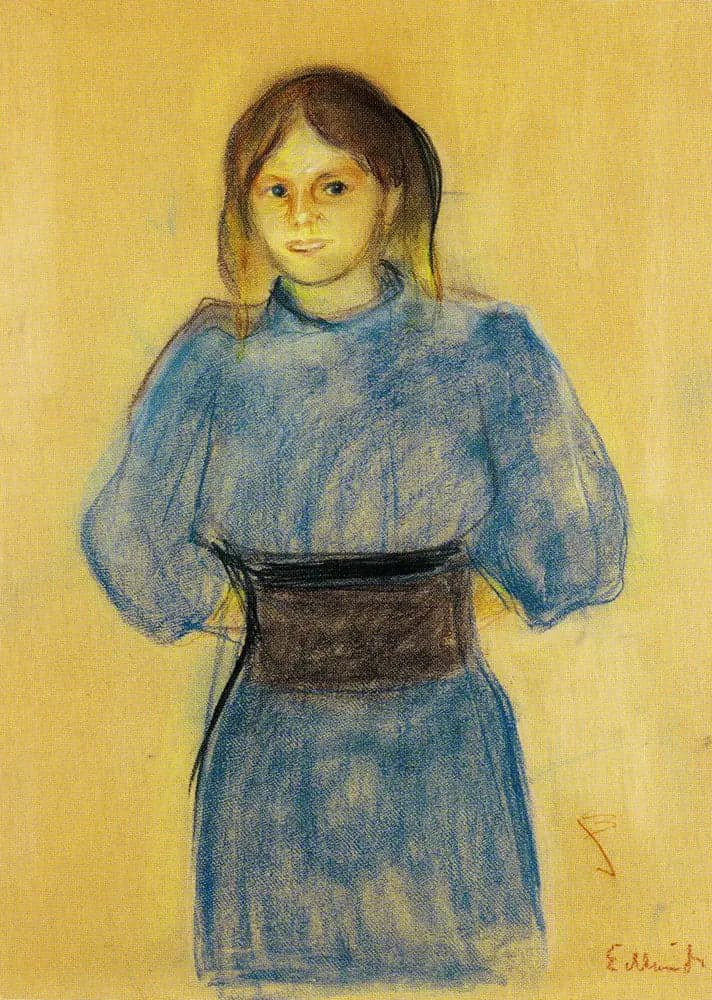
Young Woman in Blue
- Original dimensions
- 46 x 55.5 cm
- Museum
- Bergen Art Museum
- Year
- 1891
Scene depicted
In this pictorial work, Munch immerses us in the heart of a fleeting moment, capturing an enigmatic young woman enveloped in deep blue. The background, slightly blurred, suggests a dreamy and introspective atmosphere, where beauty and solitude resonate with each other. This painting unfolds in shades and emotions, revealing a delicate communion between the individual and their environment.
Historical context
Created in 1891, this painting is emblematic of the Symbolist movement that flourished in Norway at the end of the 19th century. In Bergen, where this canvas is currently displayed, Munch captured the essence of his time, filled with introspective emotions and a quest for meaning. The painting, 46 cm high and 55.5 cm wide, perfectly embodies the artistic legacy of a period marked by the desire to explore the depths of the human soul.
Place in the artist's career
The painting Young Woman in Blue is situated at a pivotal moment in Edvard Munch 's career, where his style refines and matures. Alongside works like The Scream and Madonna , this canvas shows the evolution of his gaze, moving from raw expression to a more nuanced exploration of human feelings.
Anecdote
It is said that Edvard Munch , contemplating the sea on a cool spring morning, was overwhelmed by a bittersweet melancholy. "To paint is to express my own pains," he reportedly declared, thus capturing the soul of his subjects. This inspiration becomes palpable in the painting Young Woman in Blue , where the silhouette of the young lady evokes so many emotional vibrations.