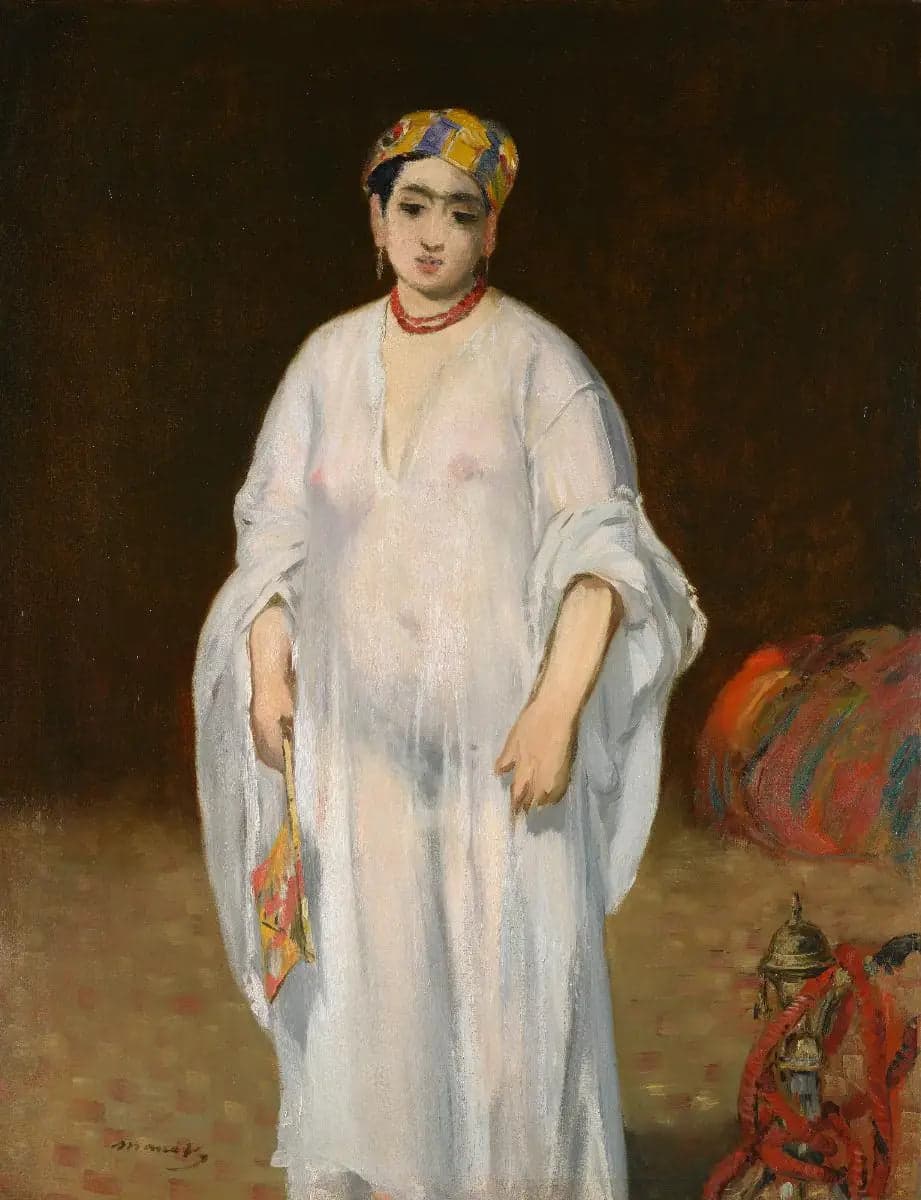
Young Woman in an Oriental Dress
- Original dimensions
- 74.5 x 96 cm
- Museum
- Emil G. Bührle Foundation and Collection
- Year
- 1871
Scene depicted
In this painting, Manet presents a female figure enveloped in a richly colored oriental dress, symbolizing mystery and exoticism. Her candid gaze seems to invite the viewer to share a moment of intimacy, a delicate encounter between the artist and his model. The vibrations of red and gold intertwine, creating a warm and captivating atmosphere, even as the desire to know more about this young woman imposes itself.
Historical context
Created in 1871 in the heart of Paris, this painting is emblematic of the Impressionist movement, revealing a significant turning point in the history of art. Manet, conquering hearts and minds, captures here the essence of an era where modernity emanates from light and color. His painting now finds refuge at the Emil G. Bührle Foundation and Collection in Zurich, a prestigious setting for this pictorial work measuring 74.5 x 96 cm.
Place in the artist's career
Through Young Woman in an Oriental Dress , Manet marks a stylistic peak in his career. Considered the father of Impressionism , this painting echoes other masterpieces such as Lunch on the Grass and Olympia , illustrating his evolution both technically and emotionally. This is a period of maturation where his bold use of light and color paves the way for a new aesthetic.
Anecdote
It is said that one spring morning, as the light played on the cobblestones of Paris, Manet crossed the gaze of a young woman draped in an oriental manner. Dazzled by the grace of her silhouette, he reportedly murmured: “Beauty is a blank canvas, and every gaze leaves an imprint.” This painting thus becomes the response to this artistic crush, capturing the ephemeral beauty of a suspended moment.