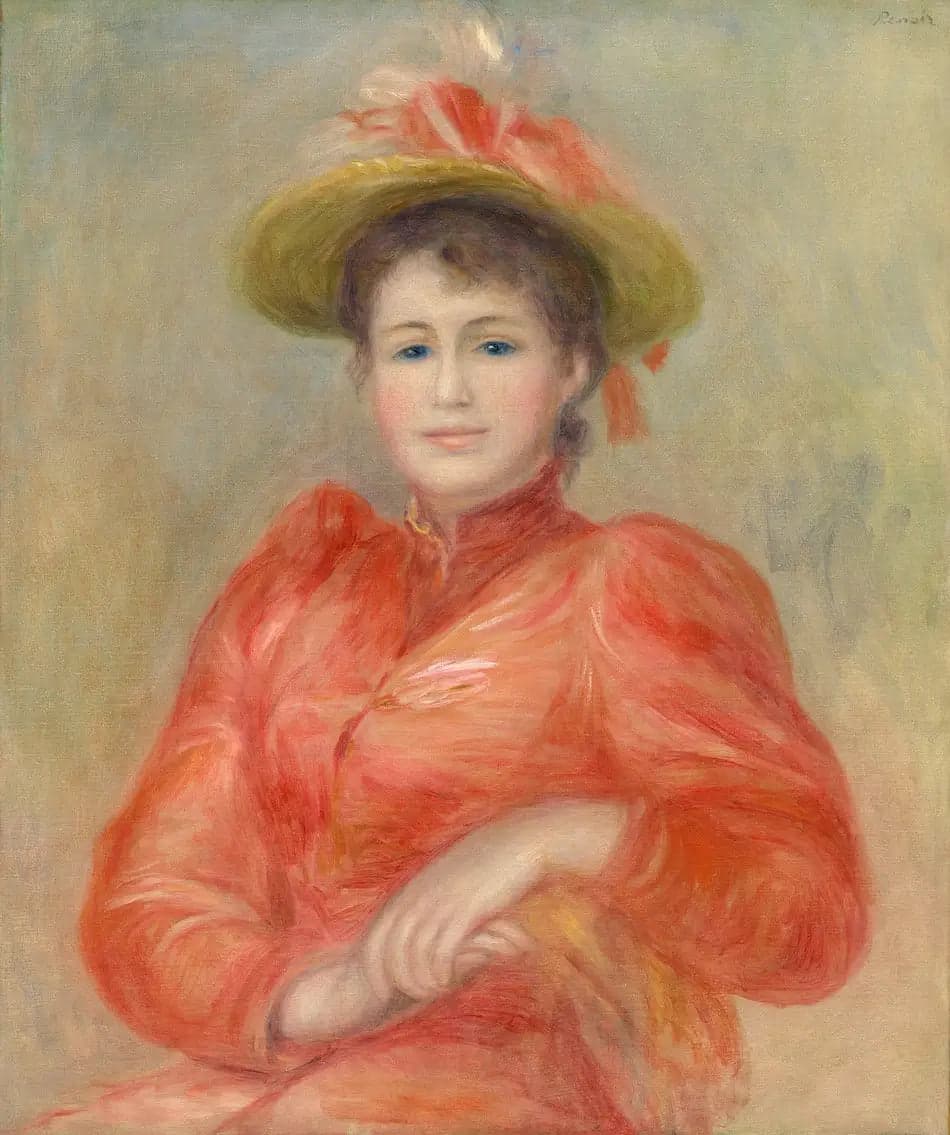
Young Woman in a Red Dress - Pierre
- Original dimensions
- 54.5 x 65.4 cm
- Museum
- Tokyo Fuji Art Museum
- Year
- 1892
Scene depicted
This painting exquisitely presents a young woman, seated, wrapped in a vibrant red dress. Her delicacy against a blurred background of greenery showcases Renoir's skill in capturing not only light but also the innate grace of his subjects. The realism of the composition and the palpable emotions hint at a fleeting intimacy, a living moment frozen forever.
Historical context
Created in 1892, this painting is emblematic of Paris, at the heart of the Belle Époque, a time marked by artistic and cultural effervescence. Part of the Impressionist movement, Young Woman in a Red Dress illustrates Renoir's art of capturing light and life, the vibrant emotions of this golden period. The painting is currently displayed at the Tokyo Fuji Art Museum , thus preserving the magic of this work in a delicate setting.
Place in the artist's career
Positioned in Renoir's career, Young Woman in a Red Dress marks a turning point towards stylistic maturity. Alongside “Luncheon of the Boating Party” and “Dance at Bougival,” this painting demonstrates his evolution towards a bolder exploration of colors and light, thus revealing the richness of his artistic language.
Anecdote
“Beauty is everywhere, you just have to know how to see it,” Renoir once said. It was on a bright spring morning, strolling through the flower-filled streets, that he spotted this elegant silhouette in a red dress. This face, tinged with softness and freshness, became a source of inspiration for this masterpiece , merging reality and dream in the painting .