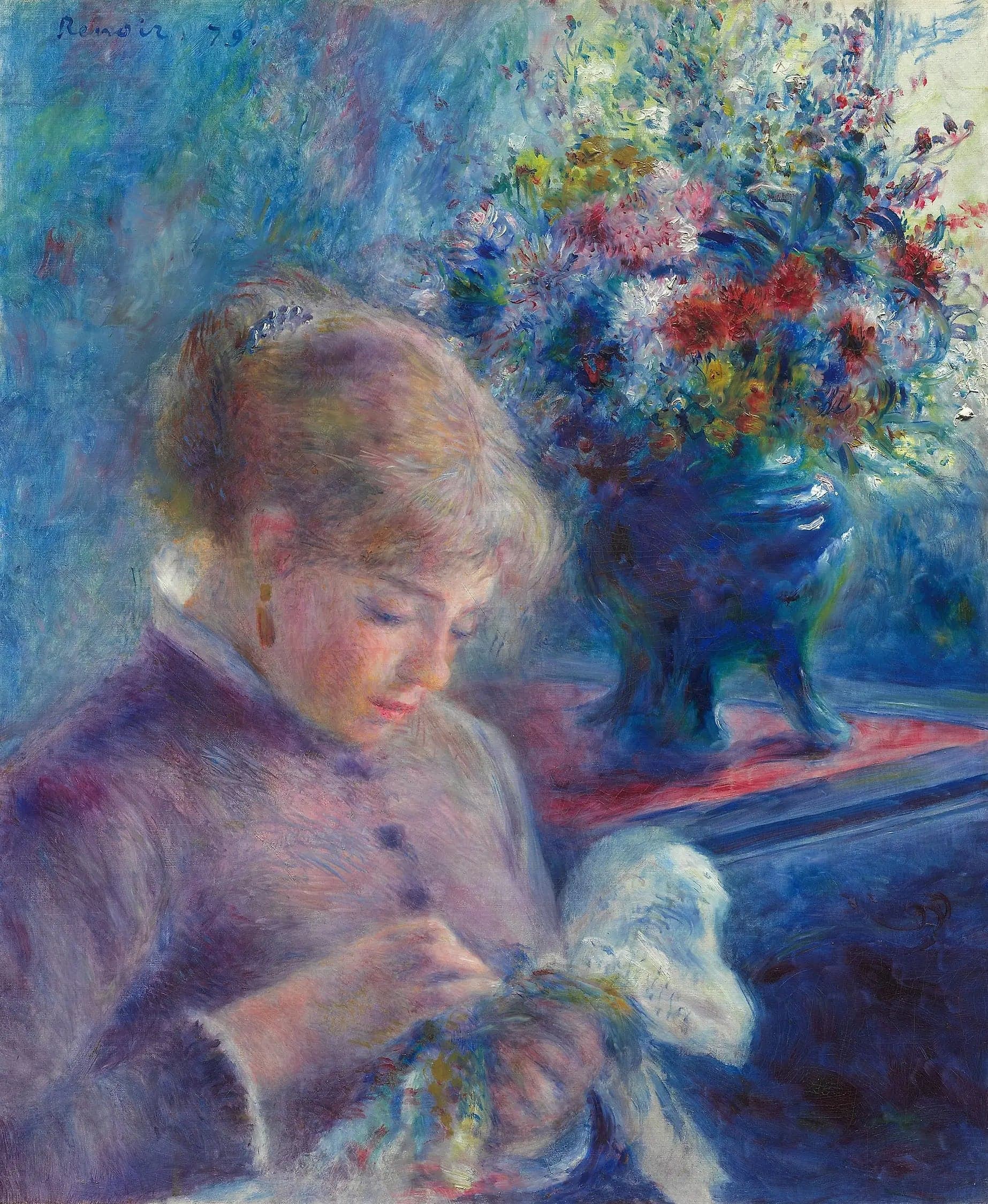
Young Woman Cousin - Pierre
- Original dimensions
- 50.3 x 61.5 cm
- Museum
- Art Institute of Chicago
- Year
- 1879
Scene depicted
In this composition, Renoir invites us to contemplate a young woman immersed in her thoughts. The softness of her expression and the gentle light surrounding her evoke an intimate and contemplative atmosphere. She embodies the ideal of feminine beauty, while allowing for the personal interpretation of each viewer. Every detail of the canvas contributes to building a story full of meaning.
Historical context
Created in 1879, this painting is located in Chicago, within the rich collections of the Art Institute. It belongs to the Impressionist movement, an innovative artistic current that marked its time with its quest for light and color. This painting, vibrant with emotions, testifies to a moment where everyday beauty is captured with delicacy.
Place in the artist's career
Young Woman Cousin is part of Renoir's mature period, a time when he refines his characteristic style. When compared to other works such as The Luncheon of the Boating Party and The Large Bathers , one perceives an evolution towards bolder and more poetic compositions. This painting marks a key step in his artistic quest.
Anecdote
Renoir once stated: “Beauty is everywhere and it is also found in humble daily life.” It is with this philosophy that he created Young Woman Cousin , perhaps inspired one sunny morning, while admiring the grace of a face encountered in the street. The evocative power of the painting resonates with this notion of fleeting beauty, to be savored in the present moment.