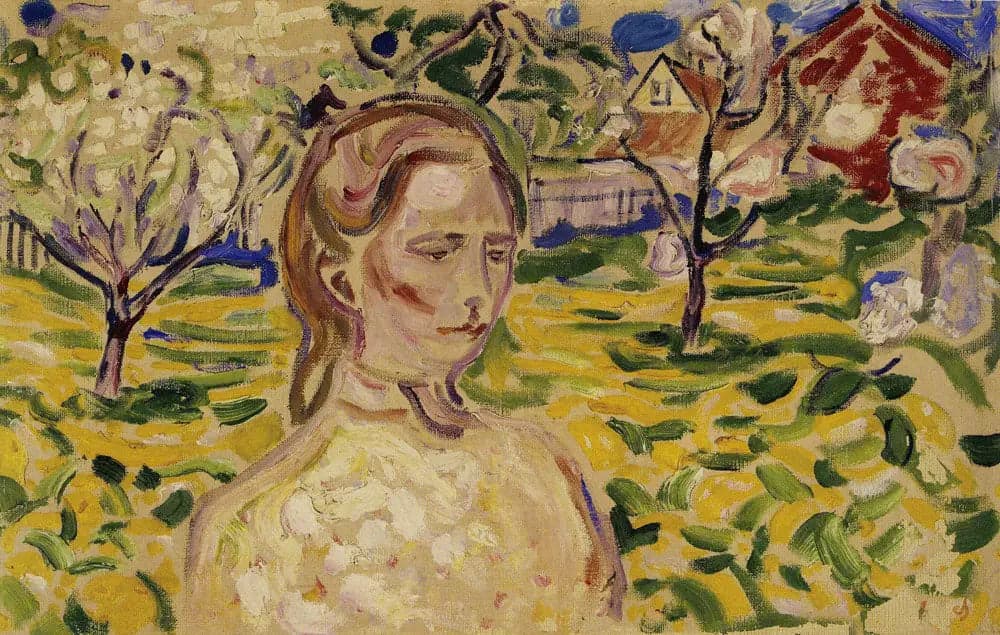
Young Woman and Ranunculus
- Original dimensions
- 85 x 52.5 cm
- Museum
- Not specified
- Year
- 1910
Scene depicted
In Young Woman and Ranunculus , Munch invites us to contemplate a young woman sitting, surrounded by the intimacy of delicate flowers. Her poised posture and contemplative gaze reveal a blend of softness and sadness. The composition of this painting immediately draws the eye and immerses the viewer in an introspective universe, where each element tells a personal story. The ranunculus, often associated with sincere love, envelops the work in a scent of innocence and aspirations, while the protagonist's gaze seems to question, as the depth of the feelings she evokes is intense.
Historical context
Created in 1910, during the cultural upheaval of the early 20th century in Norway, Young Woman and Ranunculus is part of the expressionist movement, characteristic of Munch's art. At that time, the artist, based in Oslo, began to explore intimate and emotional themes that would mark him throughout his career. This painting is currently unfinished in a private collection, testifying to its pictorial eloquence and the depth of its emotions. Reflecting an era hesitating between traditional past and modern future, the work retains a poignant beauty that continues to touch hearts.
Place in the artist's career
Young Woman and Ranunculus occupies a prominent place in Munch's artistic evolution. Created at a pivotal moment in his life, this canvas illustrates both the first phase of expressionism and the maturity of an artist in deep inner quest. Alongside The Scream , where anxiety reaches its peak, and Madonna , where fertility and sensuality meet, this painting fits into the representation of the complexity of human emotions, outlining a deeply singular emotional journey.
Anecdote
“There are feelings that only a glance can understand.” This quote could stem from Munch's reflections while creating this masterpiece . On a spring morning, he encounters the face of a young woman with a melancholic gaze, a fleeting moment transcribed onto his canvas. By capturing this moment, Munch gives birth to a work that vibrates with emotions, where the fragility of youth intertwines with the evanescent beauty of the ranunculus, symbolizing love and loss.