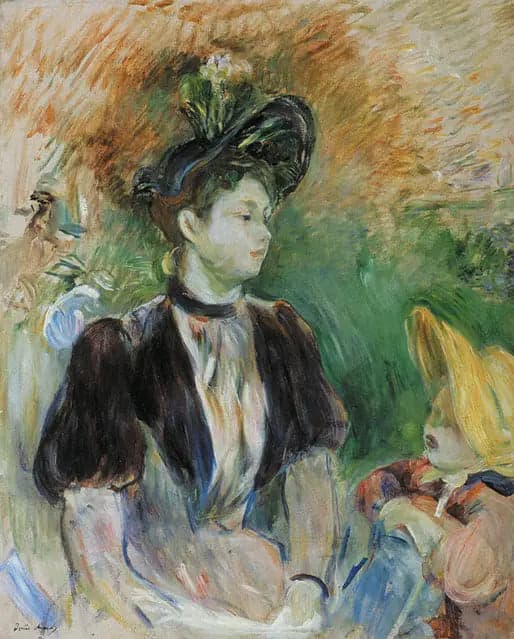
Young Woman and Child
- Original dimensions
- 61.1 x 50.5 cm
- Museum
- Yale University Art Gallery
- Year
- 1894
Scene depicted
In Young Woman and Child , Berthe Morisot captures a moment of tenderness between a mother and her child, lost in their own universe. The soft daylight filters through the window, caressing their faces and revealing the subtleties of shared emotions. This painting glorifies the idea of home, where every detail tells a story, every expression an embrace, and every gesture a promise of love.
Historical context
Created in 1894, this painting is part of the Impressionist movement that thrived in Paris, the artistic heart of the time. Under the influence of light and fleeting moments, Morisot manages to capture the essence of a gentle and caring relationship between a young woman and a child. This canvas is enriched with a warm Parisian atmosphere and is today exhibited at the Yale University Art Gallery , a sanctuary for art lovers who wish to admire this painting of great intimacy.
Place in the artist's career
This painting is at the heart of Berthe Morisot 's career, at a time when her style is refining and asserting itself. With iconic works like The Cradle and The Reading , she evolves towards a mastery of color and light, once again highlighting the importance of her presence in the Impressionist movement.
Anecdote
“Beauty lies in simple moments, those that speak to us deep within ourselves.” These words from Berthe Morisot resonate like an echo of the mornings when she would sit down to capture the light brushing a face, transforming blurry moments into a masterpiece of permanence. The emotional strength of her composition in Young Woman and Child testifies to this quest for beauty and truth.