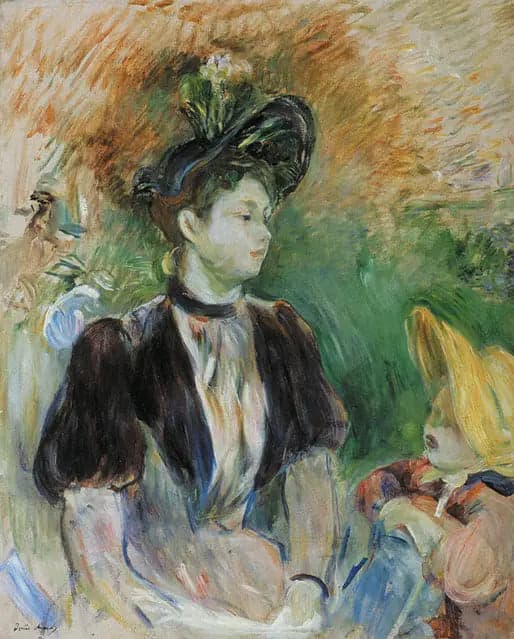
Young Woman and Child
- Original dimensions
- 50.5 x 61.5 cm
- Museum
- Hiroshima Art Museum
- Year
- 1894
Scene depicted
This canvas finely illustrates an intimate moment between a young mother and her child, enveloped in an atmosphere of sweetness and serenity. The composition, both relaxed and charged with emotion, demonstrates Morisot's talent for capturing the beauty of family bonds and the purity of shared moments.
Historical context
Created in 1894 in Paris, this painting is emblematic of the Impressionist movement, revolutionizing the artistic codes of the time. At the height of the modern era, when artists explore new ways of seeing and representing light and everyday life, Young Woman and Child captures a fleeting moment of tenderness. Today, this canvas is displayed at the Hiroshima Art Museum , preserved for future generations.
Place in the artist's career
Situated at a key moment in her career, Young Woman and Child marks a period of maturity for Morisot. When compared to The Cradle and The Garden of My Mother , one can observe an evolution in her technique, gradually freeing herself from conventions to embrace a more personal and emotional expression.
Anecdote
“To paint is to capture the breath of life.” These words resonate through her works, where each reflects a moment, a feeling. The inspiration for Young Woman and Child was born one spring morning when Morisot, strolling in her home, encountered the bright smile of a child, illuminating her heart and her canvas with the sweetness of childhood.