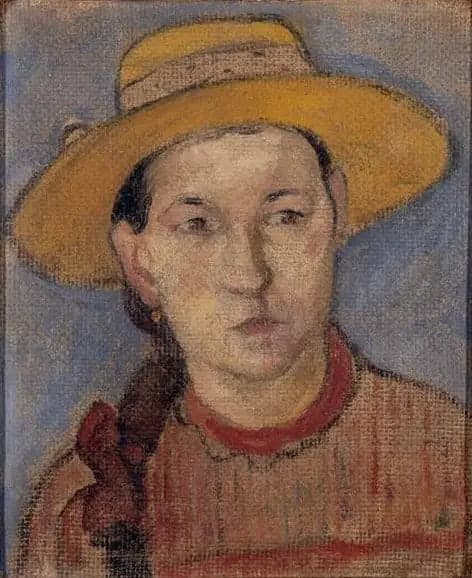
Young Tahitian
- Original dimensions
- 30 x 36 cm
- Museum
- Museum of Modern Art of Troyes
- Year
- 1891
Scene depicted
The painting “Young Tahitian” transports us to a universe where beauty is striking. A young woman, motionless, radiant, dressed in vibrant patterns, embodies grace and serenity. She is the reflection of a cultural identity, the soul of this island that Gauguin loved so much, silently telling her story through her delicate features and the lush background.
Historical context
Created in 1891, in the heart of the sweet and enchanting Tahiti, this painting is emblematic of the post impressionist movement. Paul Gauguin , one of the pioneers of this era, captured the essence of a culture so rich that it cradled his artist's soul. Today, this canvas is preserved in the Museum of Modern Art of Troyes, where it continues to attract the admiring gazes of visitors.
Place in the artist's career
This canvas positions Paul Gauguin in his period of flourishing, marking a turning point in his career. Echoing “Vision of the Night” and “La Orana Maria,” we observe an evolution not only technical but also emotional in his artistic expression. Each painting comes to life with a different depth, translating a rich inner journey of reflections.
Anecdote
“I immersed myself in the light, and the light gave me this canvas ,” Gauguin might have said about his inspiration for this masterpiece . Imagine him before a golden sky at dawn, contemplating the simple beauties of Tahitian life that unfolded before him, blending into his vision the sweetness and warmth of an authentic morning.