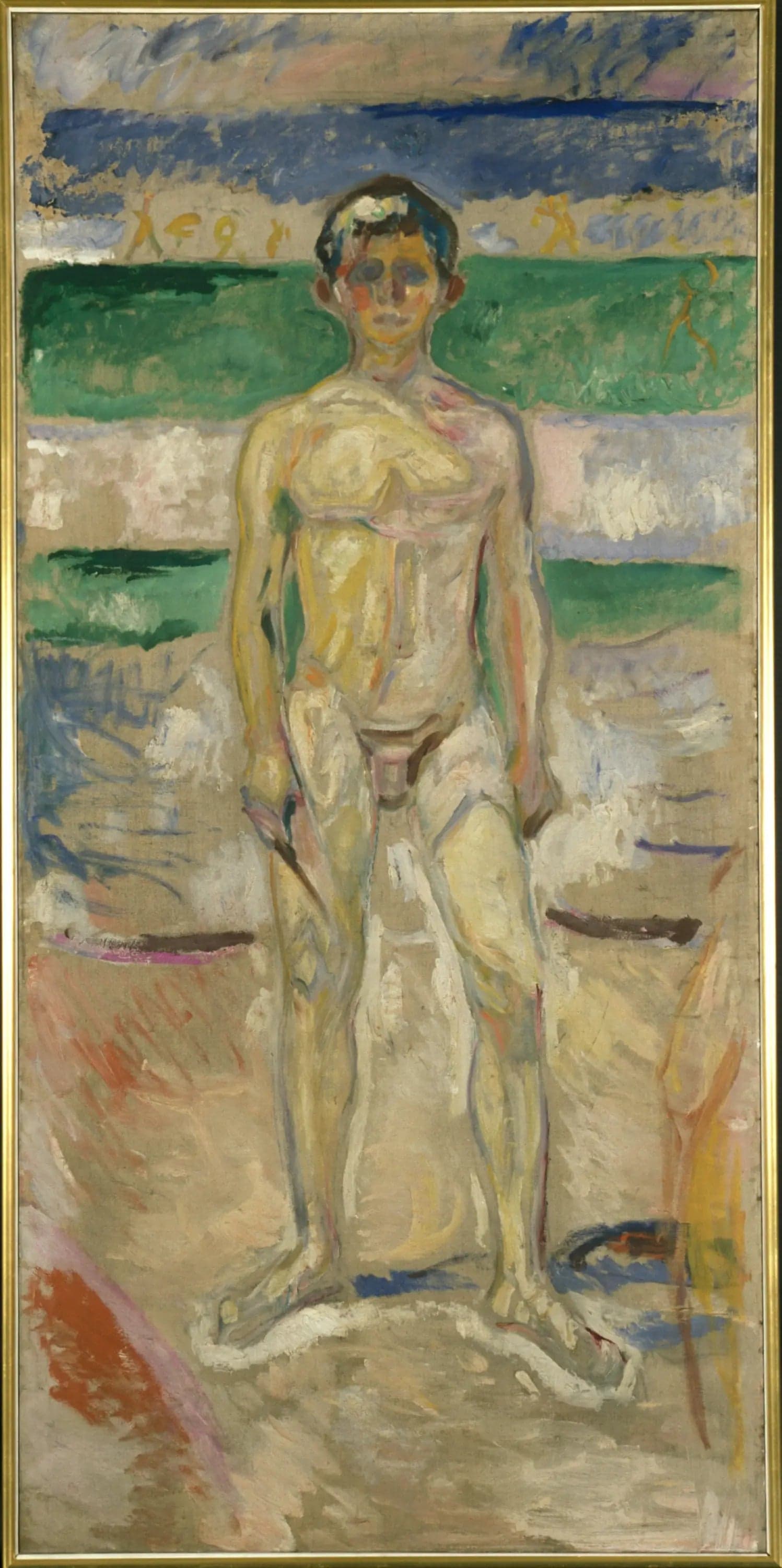
Young Person
- Original dimensions
- 96 x 201 cm
- Museum
- Folkwang museum
- Year
- 1910
Scene depicted
The painting, whose composition shows a young person lost in thought, suggests an inner dialogue between solitude and hope. The delicate features of the face, combined with a posture that is both open and closed, testify to the fragility of the human soul. Munch, with his penetrating gaze, manages to capture that essence so universal that is youth, full of journeys to come.
Historical context
Created in 1910 in Oslo, this painting is a vibrant testimony to the expressionist movement, which emerged at that time. Each layer of the canvas reveals the intensity of human emotions and the anxiety of a time in full mutation. Today, the painting is located at the Folkwang museum in Essen, an iconic city for the dissemination of modern art in Europe.
Place in the artist's career
This canvas marks a crucial step in Munch's evolution. After works such as “The Scream” and “The Madonna,” “Young Person” represents a period of maturity where the artist explores more nuanced feelings. It positions itself as a bridge between the boldness of expressionism and a more introspective exploration of human emotions.
Anecdote
“Art must be a cry of the soul,” said Munch, thus evoking the very essence of his masterpiece . Inspired by a silent alley from his childhood, he captured the fleeting moment of a life in becoming, illustrating not only a face but a rich inner universe of promises and anxieties.