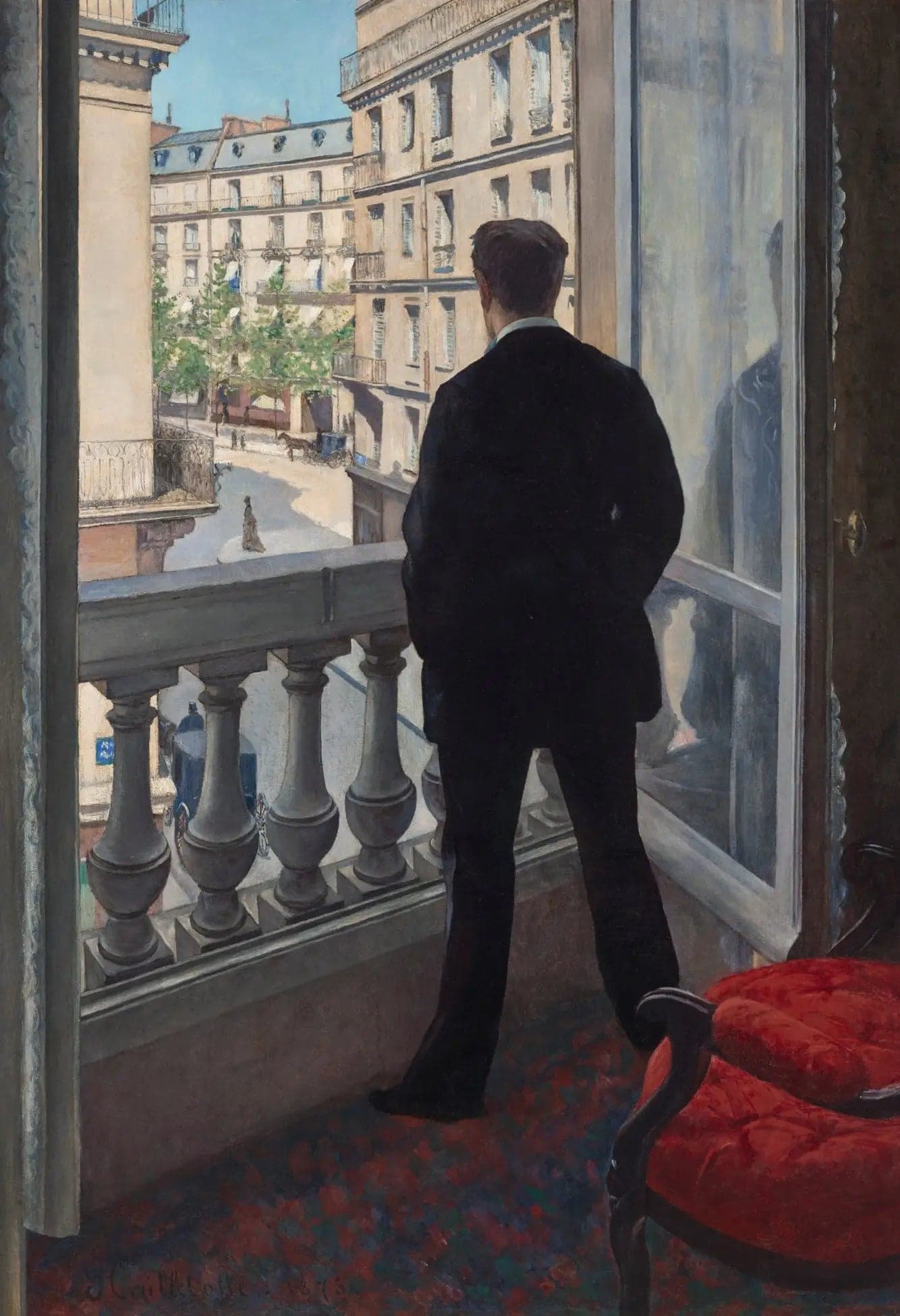
Young Man at His Window
- Original dimensions
- 82 x 117 cm
- Museum
- rue de Miromesnil
- Year
- 1875
Scene depicted
The painting “Young Man at His Window” immerses us in the intimacy of a Parisian interior. The young man, a pensive silhouette, stands before an open window, symbolizing escape and the desire for a vibrant outside world. The nuances of light filter through the glass, evoking the tranquility of the moment while suggesting the mixed sounds of urban life below.
Historical context
Painted in 1875, this canvas is part of the Impressionist movement and reflects the artistic effervescence of Paris at the time. Caillebotte, one of the leaders of this movement, captured the essence of urban life, during a period where modernity clashes with tradition. The painting is currently exhibited at the museum on rue de Miromesnil, where it attracts admirers from around the world, curious to discover this iconic work.
Place in the artist's career
This canvas is one of the first major milestones for Caillebotte on the path to his artistic recognition. It marks a turning point towards a bolder representation of everyday life, alongside his works “The Bridge of Europe” and “The Crane,” where the manipulation of perspectives and lights illustrates his burgeoning creative genius.
Anecdote
As Caillebotte said, “Truth lies in the light and shadows that dance on a face.” Inspired by a spring morning in Paris, he crossed the gaze of a young man, lost in thought, behind a window. This chance encounter gave birth to this masterpiece , capturing a fraction of a second of contemplation and dream.
Major exhibitions
second Impressionist exhibition