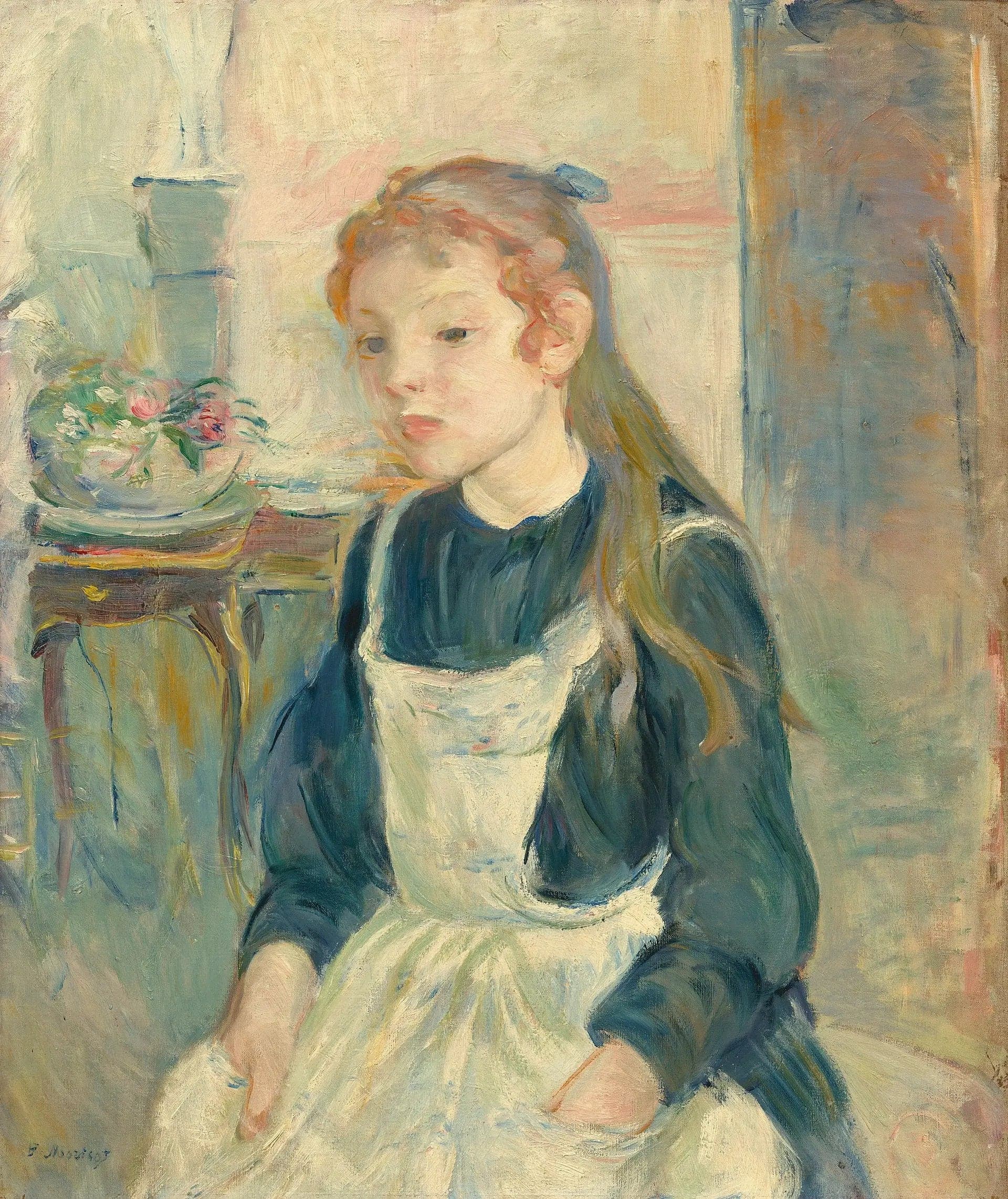
Young Girl with an Apron
- Original dimensions
- 54.6 x 65 cm
- Museum
- National Gallery of Art
- Year
- 1891
Scene depicted
In this painting , a young girl, dressed in a white apron, stands in a light-filled setting, embodying both simplicity and elegance. The tender and focused gaze of her face highlights the beauty of the everyday. Morisot sought to celebrate the grace of young women, capturing an essence of tranquility and joy through this intimate scene illuminated by natural light.
Historical context
Created in 1891, the painting "Young Girl with an Apron" is set in the vibrant context of Paris Impressionism , where Berthe Morisot , an emblematic figure of this movement, redefined the beauty of everyday relationships. This canvas , currently on display at the National Gallery of Art , reflects a time when art became a mirror of human emotions and family life. Its dimensions, 54.6 x 65 cm, are perfectly proportioned to capture the attention and tenderness of a moment frozen in time.
Place in the artist's career
The painting "Young Girl with an Apron" represents a pivotal moment in the career of Berthe Morisot , where her tender and Impressionist style beautifully merges with themes of domestic life. In parallel, works like "The Cradle" (1872) and "Child with a Toy" (1886) show the evolution towards an increasingly intimate and personal representation of femininity and childhood, paying tribute to everyday emotions.
Anecdote
It is said that Morisot found inspiration for this masterpiece on a sunny morning while observing a young girl in the blooming gardens of Paris. "Beauty hides in the simplicity of daily gestures," she would assert, and this painting is a splendid illustration where each brushstroke evokes an atmosphere of calm and softness. The composition of this painting is an open window to the feminine sensitivity of the time.