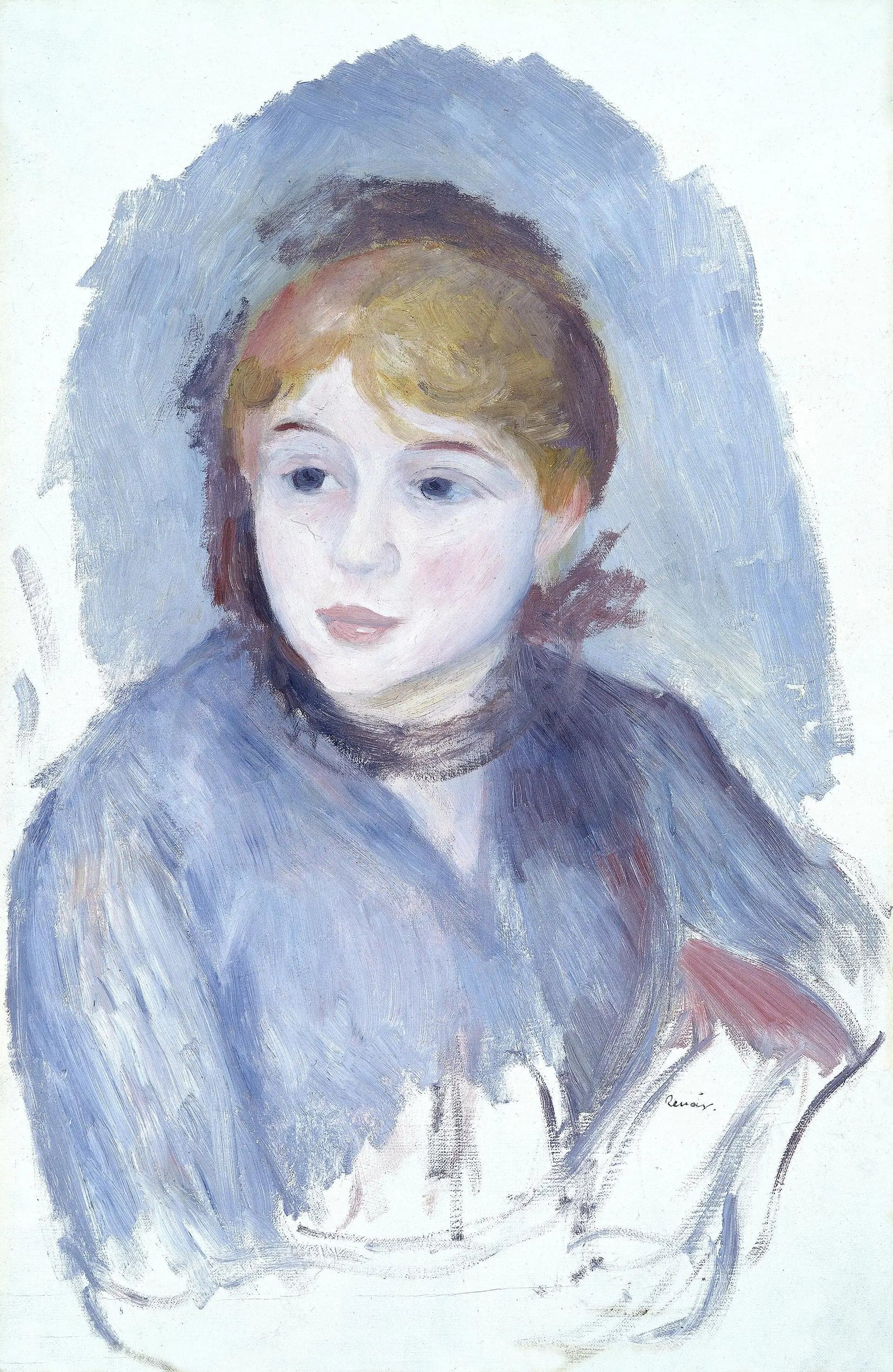
Young Girl in Blue - Pierre
- Original dimensions
- 35.6 x 54.7 cm
- Museum
- National Museum of Cardiff
- Year
- 1882
Scene depicted
In “Young Girl in Blue,” Renoir reveals the graceful silhouette of a young girl dressed in a blue dress, sitting in a garden. The light gently filters through the foliage, illuminating her serene face, while a soft breeze makes the fabrics flutter. The artist captures the beauty of the moment, where love and youthful hopes seem to pulse with every brushstroke, making this canvas a true ode to the infinity of possibilities.
Historical context
Created in 1882, in the beautiful city of Paris, this painting embodies the very essence of the Impressionist movement. Through this painting, Renoir captures the light and life of his time, a moment when art transcends norms and invites wonder. Today, this canvas is carefully preserved at the National Museum of Cardiff , a sanctuary dedicated to art, where visitors can admire every detail of this iconic work .
Place in the artist's career
This painting ranks high in Renoir's career, illustrating his evolving style. After “Luncheon of the Boating Party” and before “Dance in the City,” “Young Girl in Blue” marks a period where Renoir skillfully blends luminism and the tenderness of portraits. It is a painting that is not just a representation, but a testament to his growing expertise and his intimate approach to art.
Anecdote
Renoir once said: “Life is beautiful, but even more so through a brush that plays with light.” It is in this quest to capture the brilliance and freshness of a spring morning that this pictorial work was born, inspired by a fleeting encounter in a blooming garden. This painting resonates like a sweet memory, evoking innocence and the joy of living.