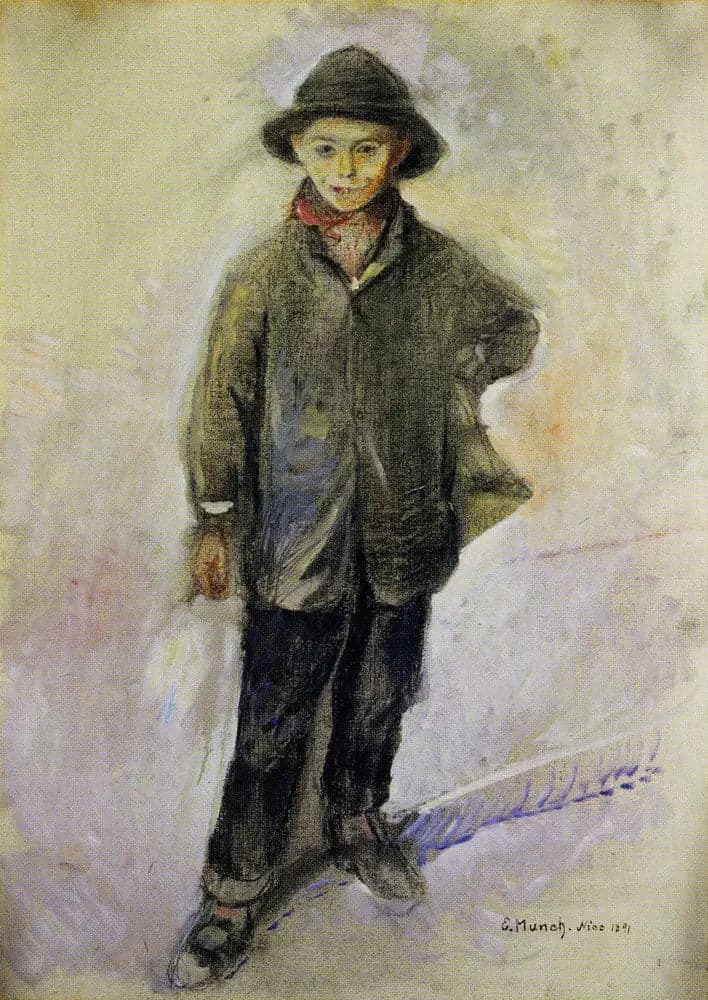
Young Fisherman of Nice
- Original dimensions
- 52 x 40 cm
- Museum
- Not specified
- Year
- 1891
Scene depicted
The painting “Young Fisherman of Nice” features a young man captivated by the azure horizon. The scene depicts a contemplative pause, an interlude between the sea of a bright blue and the land. Munch's art manages to encapsulate this fragility of the moment, evoking tranquility mixed with a certain sadness, as if the fisherman were waiting for something much greater than himself in this vast expanse of water.
Historical context
Created in 1891, this painting is among the first works of Edvard Munch , a key figure in the expressionist movement. The painting evokes the French Riviera, with Nice as a backdrop, symbolizing both the natural beauty and the solitude of a young fisherman. Although the current location of the painting is unknown, its dimensions, 52 x 40 cm, make it an intimate and engaging work.
Place in the artist's career
This painting is part of a pivotal phase in Munch's career, where he begins to explore themes of solitude and anxiety. Compared to other masterpieces like “The Scream” and “The Madonna,” “Young Fisherman of Nice” marks an evolution: from poignant realism to a more introspective exploration of his emotions.
Anecdote
“Nature is the soul of man, each of its beats resonates within me” Munch might have said, inspired by that quiet day when he observed a young fisherman on the beach. It is in this blend of contemplation and melancholy that the painting comes to life, capturing the essence of the moment, an emotion mixed with admiration and tenderness.