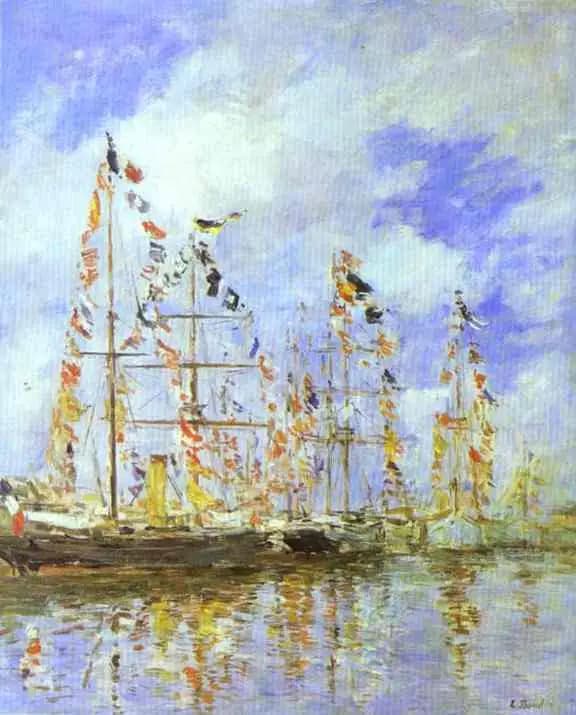
Yacht Basin in Trouville-Deauville
- Original dimensions
- 37.1 x 45.8 cm
- Museum
- National Gallery of Art
- Year
- 1896
Scene depicted
This painting reveals a lively panorama of the port of Trouville. Yachts sway gracefully on the waves, the sun reflecting on the water, while human figures bustle at the bottom of the painting. The white sails contrast with the blue-green hues of the sea, inviting the viewer to feel the energy of this place of leisure and exchange, a symbol of a French art of living.
Historical context
Created in 1896, the painting "Yacht Basin in Trouville-Deauville" is a vibrant testimony of the Impressionist movement. Located in Normandy, this pictorial work takes advantage of the changing lights of the French coastline, immortalizing a lively and vibrant port life scene. Today, this canvas is carefully preserved at the National Gallery of Art , offering its visitors a window into the golden age of the 19th century, when Trouville-Deauville was a hotspot for summer bourgeoisie.
Place in the artist's career
"Yacht Basin in Trouville-Deauville" stands as a masterwork in Boudin's career, marking a period of maturity. At the crossroads of Impressionism and Realism , it evokes works such as "The Beach at Trouville" and "The Port of Honfleur," and shows the evolution of his approach to light and space, which would later be beautifully developed by his contemporaries.
Anecdote
Eugène Boudin once stated: "I paint the sea because it never stops singing thanks to the wind." On a freshly sunny morning, by the basin, a gentle breeze carried with it the salty scent. It is in this atmosphere that Boudin captured the very essence of the canvas , translating the fleeting emotion of a moment suspended between sky and sea.