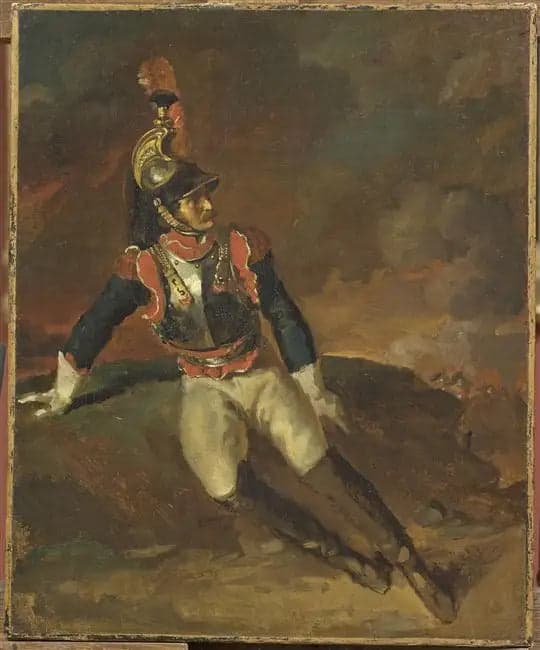
Wounded Cuirassier
- Original dimensions
- 38 x 46 cm
- Museum
- room 941
- Year
- 1813
Scene depicted
The painting depicts a French cuirassier, wounded on the battlefield. Tears and dust mingle, while the blood of heroism slowly flows over his armor, a symbol of bravery. Géricault, through this canvas , captures the very essence of sacrifice and struggle, paying tribute to forgotten soldiers.
Historical context
Created in 1813, the painting "Wounded Cuirassier" is rooted in a tumultuous era, resonating with the echoes of the French Revolution and the Napoleonic Wars. Made in Paris, this work belongs to the romantic movement, embodying tragedy and heroism. Today, this canvas is found at the heart of the museum, room 941, testifying to its timeless legacy.
Place in the artist's career
Signing here a turning point in his career, "Wounded Cuirassier" is situated between his first recognition with " The Raft of the Medusa " and the more intimate explorations of his later work. This painting crystallizes a period of emotional development, contrasting with works such as "La Rue de Bonne-Nouvelle" which also reflect a similar social anxiety.
Anecdote
“Human pain is an unsuspected beauty,” Géricault might have said, his gaze lost in the trenches of a battle, searching for faces of courage and suffering. That morning, the air was thick with the sound of drums, the cries of men in struggle, feeding the inspiration for this masterpiece , "Wounded Cuirassier".