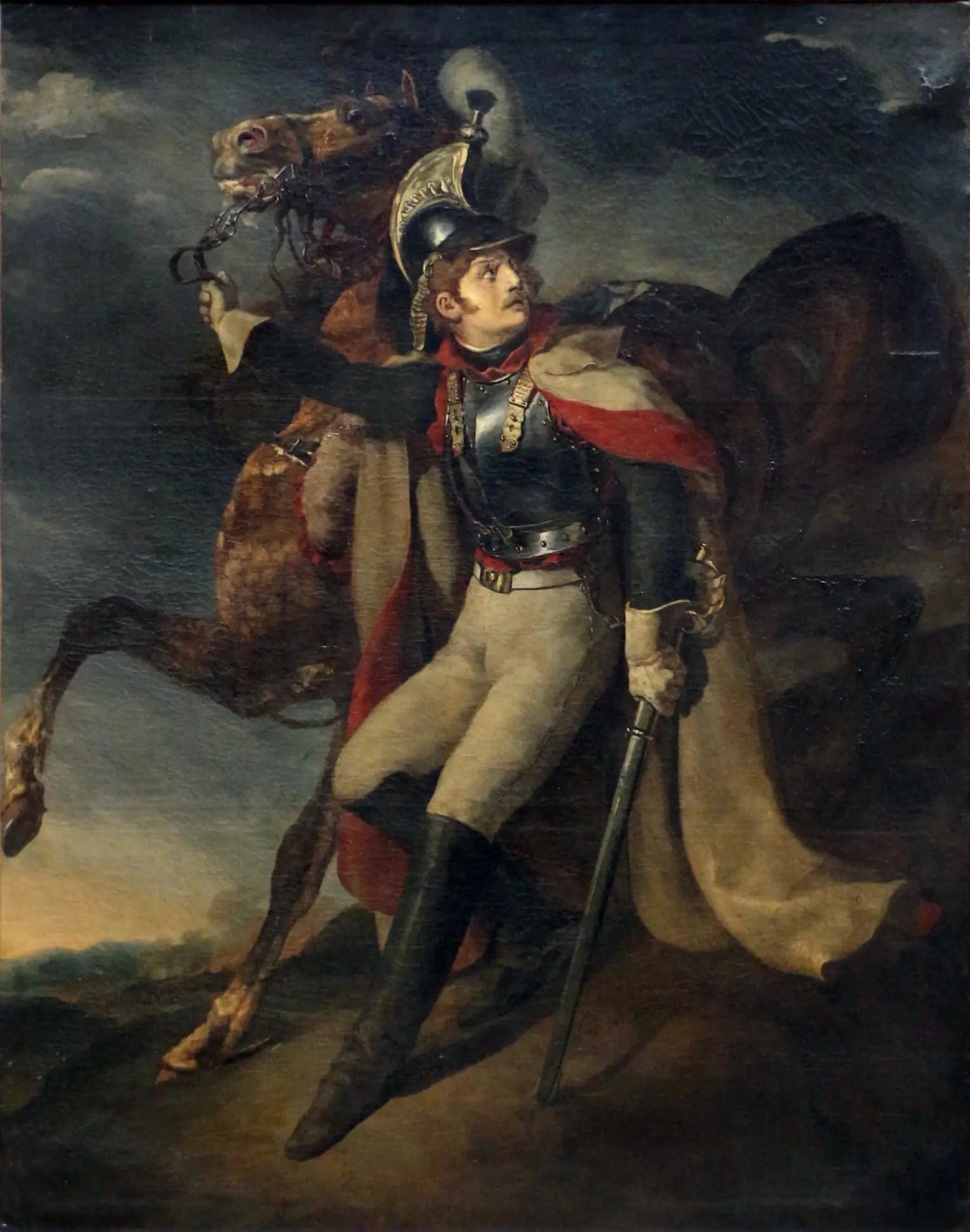
Wounded Cuirassier Leaving the Fire
- Original dimensions
- 294 x 358 cm
- Museum
- room 700
- Year
- 1814
Scene depicted
This canvas depicts a cuirassier, a symbol of military bravery, leaving the battlefield, wounded. The palpable emotion of this moment, between pain and dignity, resonates not only through the soldier's battered body but also through the dynamics between the colors and the light that envelop the scene. Géricault manages to crystallize a profound human story, imbued with suffering and resilience.
Historical context
Created in 1814, this painting is set against the tumultuous backdrop of post-Napoleonic France. The canvas is currently displayed in room 700 of a renowned Parisian museum. Géricault, a major figure of the romantic movement, captures in this work all the drama of the era and the intensity of human emotions.
Place in the artist's career
This painting represents a turning point in Géricault's career, a masterpiece that foreshadows his transition to more dramatic subjects, while establishing parallels with other works like " The Raft of the Medusa " and "Chasseur de la Garde". It marks the peak of his romantic style, where the brutal expression of emotions takes precedence over mere representation.
Anecdote
“The subject haunts me, like a memory of a distant battle.” This fictional quote from Géricault evokes the emotional power that drives him during the creation of this canvas . Imagine him, inspired by tales of bravery and suffering, standing before the dramatic scene that germinates in his imagination with each brushstroke.
Major exhibitions
Salon of 1814