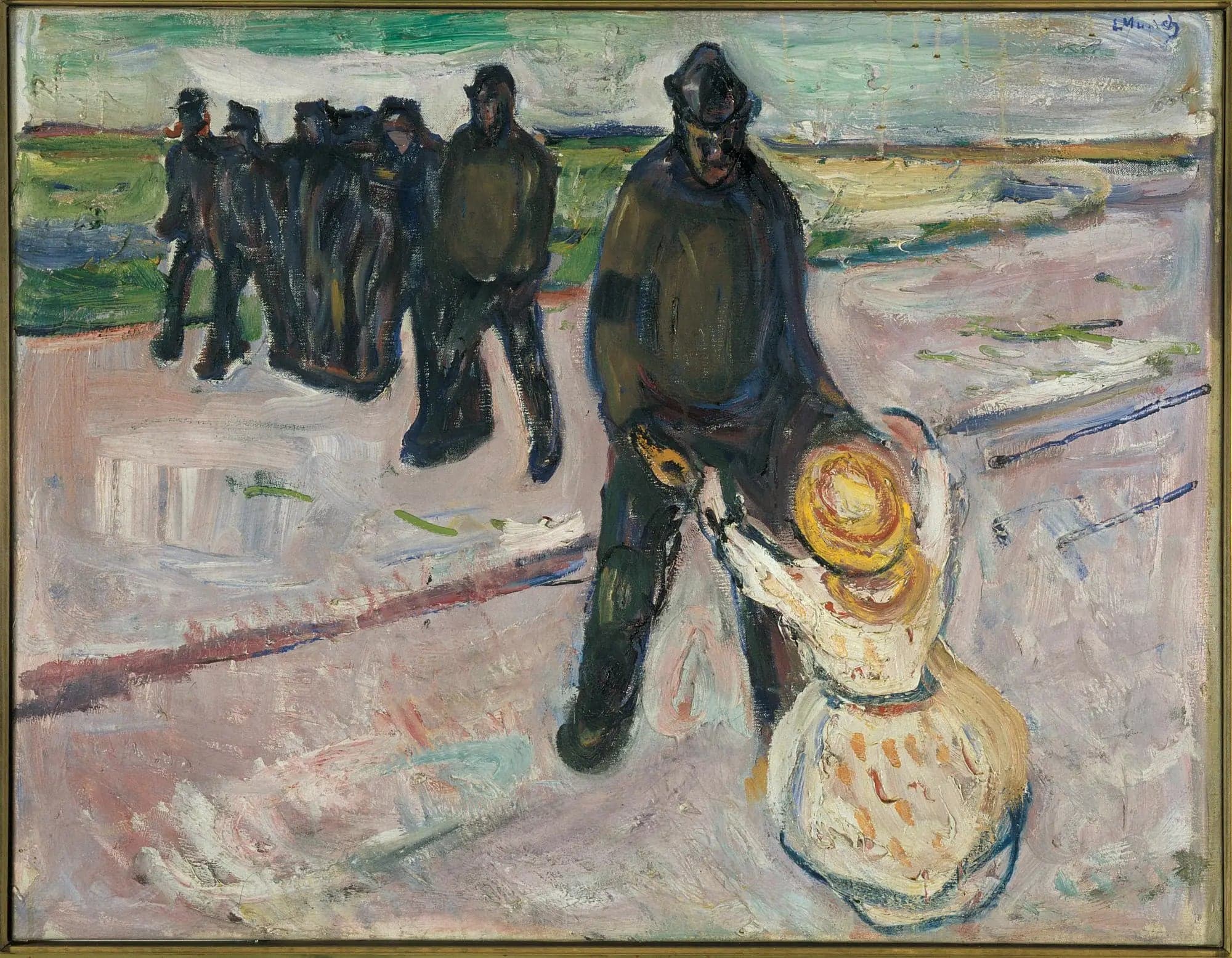
Worker and Child
- Original dimensions
- 91 x 70 cm
- Museum
- Munch Museum
- Year
- 1907
Scene depicted
In this pictorial work, Munch captures a poignant interaction between a worker and a young child, symbols of the struggles and hopes of the time. The painting depicts the simplicity of a shared moment, transcribing the beauty of childlike tenderness rooted in a tumultuous social context. The expression on their faces evokes a mix of fatigue and hope, transcending the everyday to touch the universal.
Historical context
Created in 1907 in Oslo, this painting is part of the expressionist movement, emblematic of a period when art sought to transcend mere representation. The painting is currently housed in the Munch Museum, where it receives constant attention. Its dimensions of 91 x 70 cm enhance its presence, inviting each observer to immerse themselves in an atmosphere filled with emotions.
Place in the artist's career
Worker and Child represents a significant milestone in Munch's career, marking his transition towards a broader exhibition of human emotions. Compared to works like The Scream or The Madonna, this painting illustrates an evolution towards poignant simplicity, consolidating his status as an innovative artist at the heart of expressionism .
Anecdote
Edvard Munch once stated: "Art must not only reproduce reality but reveal it." Imagine this moment in the heart of spring 1907, on a street in Oslo, where the light danced on a child's face. It is in this ambiance that the evocative power of the painting Worker and Child takes root, blending the everyday with a deep sense of human connection.
Major exhibitions
Munch og Warnemünde: 1907-1908