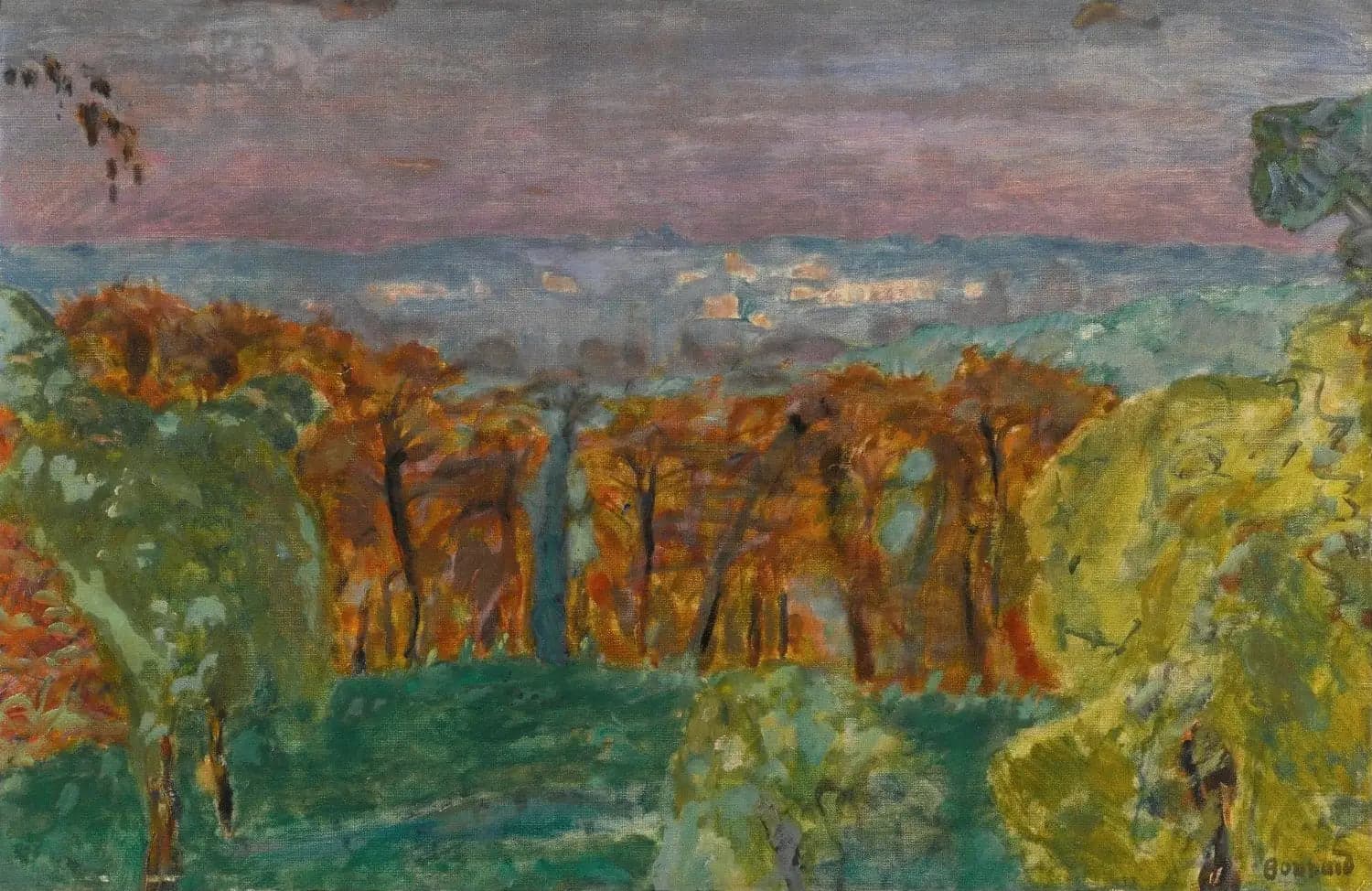
Wood in Autumn
- Original dimensions
- 71 x 46 cm
- Museum
- Not specified
- Year
- 1939
Scene depicted
"Wood in Autumn" depicts a forest bathed in the warm hues of autumn, revealing a composition where each element is harmoniously integrated. The trees, majestic, seem to whisper secrets and memories to the viewer. Light plays a predominant role, creating shadows that invite contemplation. The painting captures the very essence of a transitional season, a moment suspended in time, rich in emotions.
Historical context
Created in 1939, in a world in full turmoil, the painting "Wood in Autumn" by Pierre Bonnard is part of a post-impressionist movement with rich and varied influences. The work was born in France, a country where art has always held a prominent place in culture. Currently, this canvas remains accessible to the eyes of enthusiasts in private collections, with no known museum, and its exact dimensions, 71 x 46 cm, highlight the finesse of its representation.
Place in the artist's career
With "Wood in Autumn," Bonnard demonstrates his artistic maturity. This canvas resonates with other significant works such as Monet's "Water Lilies," where nature is also a source of inspiration. In parallel with Botticelli's "The Birth of Venus," "Wood in Autumn" is part of an unceasing quest for light and color, reflecting the stylistic evolution of the artist.
Anecdote
"Nature is a living poem at every moment," said Bonnard. The inspiration for this masterpiece is said to have arisen during a walk in the woods on an autumn morning. The golden and vibrant red leaves were accompanied by a gentle whisper of the breeze, a olfactory memory of the scent of damp earth mixed with the spices of the forest. This canvas thus becomes the echo of the emotion evoked by nature.