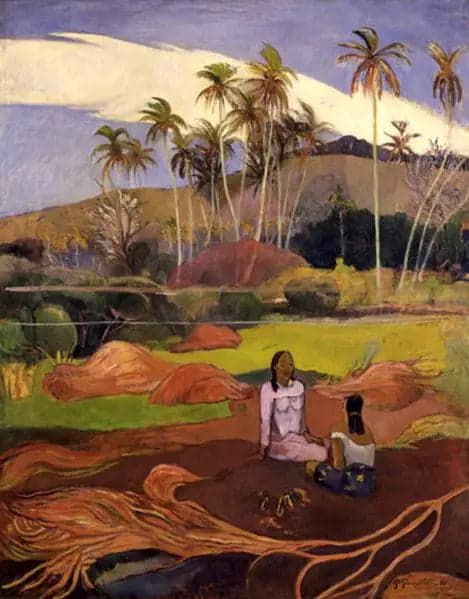
Women near the Palms
- Original dimensions
- 72 x 92 cm
- Museum
- Not specified
- Year
- 1891
Scene depicted
This painting depicts with unparalleled grace the intimacy between women and their lush environment. In the background, majestic palm trees provide a backdrop where nature intertwines harmoniously with humanity. The female figures, casually posed, evoke a simplicity and authentic beauty, representing frozen moments where time seems suspended. Every detail of this painting calls for endless contemplation, lifting our gaze to the unsuspected mysteries of life.
Historical context
This painting was created in 1891, in a context marked by the vibrant atmosphere of Polynesia, which was still little explored. Paul Gauguin , a nurturing figure of the symbolist movement, immersed himself there, far from European conventions. Although the current location of this canvas is not specified, it reflects a time when art became a quest for authenticity and individual expression. Its dimensions, 72 by 92 centimeters, carry a grandeur that one can almost touch.
Place in the artist's career
This painting stands as a turning point in Gauguin's career, marking the peak of his Tahitian period. At the crossroads between impressionism and symbolism , it recalls works such as The Vision After the Sermon and Parau na te Varua ino , where Gauguin explores the spiritual and the sensory. This search for depth and meaning foreshadows the future masterpieces that will follow, demonstrating great stylistic maturity.
Anecdote
“I prefer to paint souls rather than bodies.” This thought of Gauguin, while he was on the island of Tahiti, resonates at the heart of his masterpiece . One intoxicating morning, enveloped by the fragrances of exotic flowers and the gentle sound of waves, the artist captured not only silhouettes but the very essence of Polynesian life, making Women near the Palms a true ode to femininity and nature.