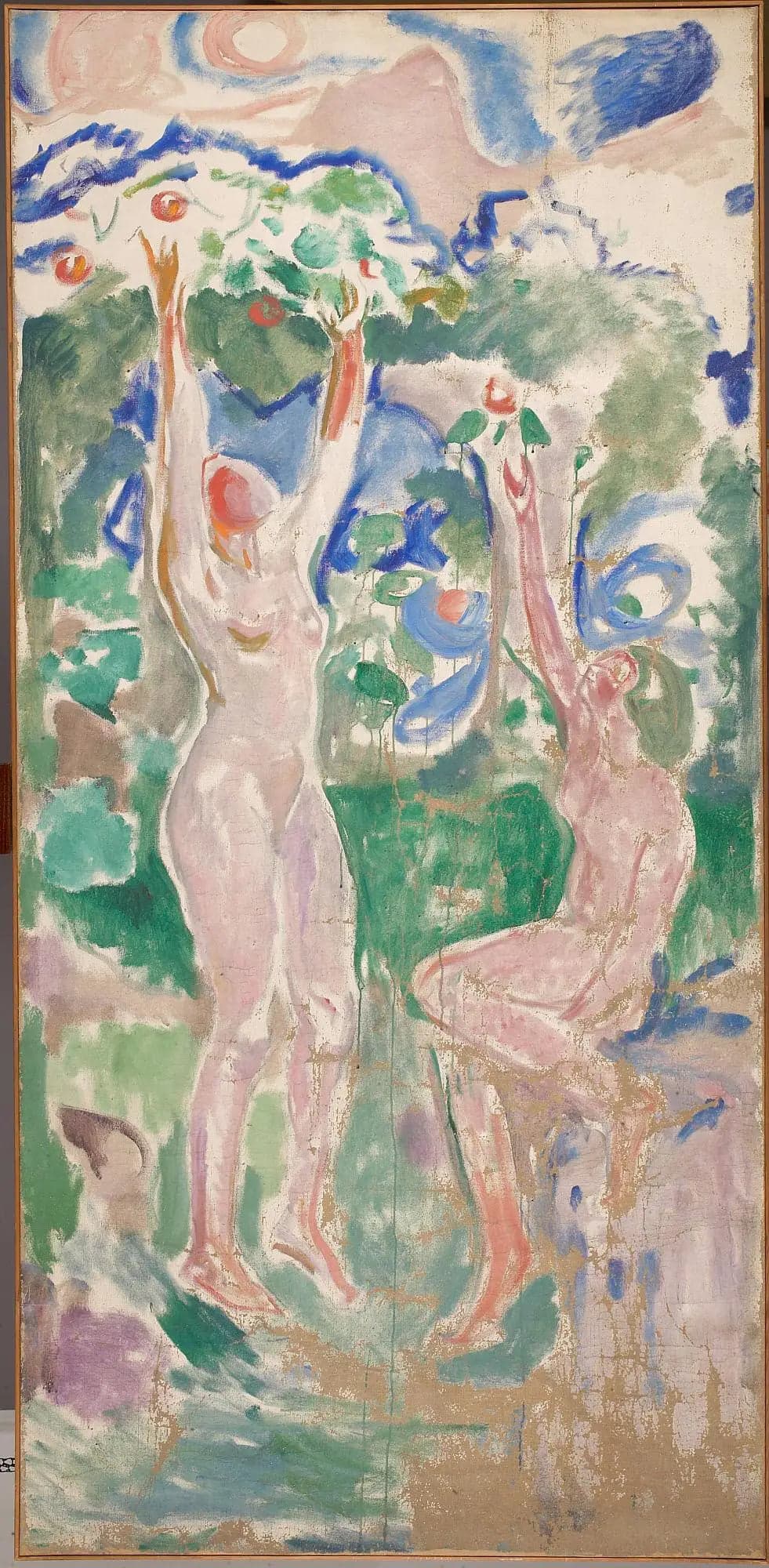
Women at the Harvest
- Original dimensions
- 105.5 x 260.5 cm
- Museum
- Munch Museum
- Year
- 1910
Scene depicted
The composition of the painting "Women at the Harvest" evokes female silhouettes bending over golden fields, illustrating the harmony between man and nature. The women, figures of resilience and hard work, are surrounded by the warm and vibrant colors of the harvest, which also represents a season of gathering and gratitude. This painting tells a timeless story of devotion to the land.
Historical context
Created in 1910, in the heart of the city of Oslo, this iconic canvas belongs to the expressionist movement. "Women at the Harvest" is an ode to rural life and nature, capturing a time when Munch explored themes related to human emotions. The painting is currently located at the Munch Museum, where visitors can admire its impressive dimensions, symbols of the emotional richness of its creator.
Place in the artist's career
This painting marks a pivotal period in Munch's career, between his promising beginnings and his artistic maturity. Alongside other works like "The Scream" and "Love," "Women at the Harvest" illustrates the evolution of his expressionism , combining refined technique and deep emotions.
Anecdote
Edvard Munch once expressed: "The windows of the soul are often tinted with a particular light, that of the ordinary." It is in this introspection, during a bright morning in the countryside, that the inspiration for this masterpiece came to life. Observing the women working in the fields, he felt a deep connection with their simplicity and strength.