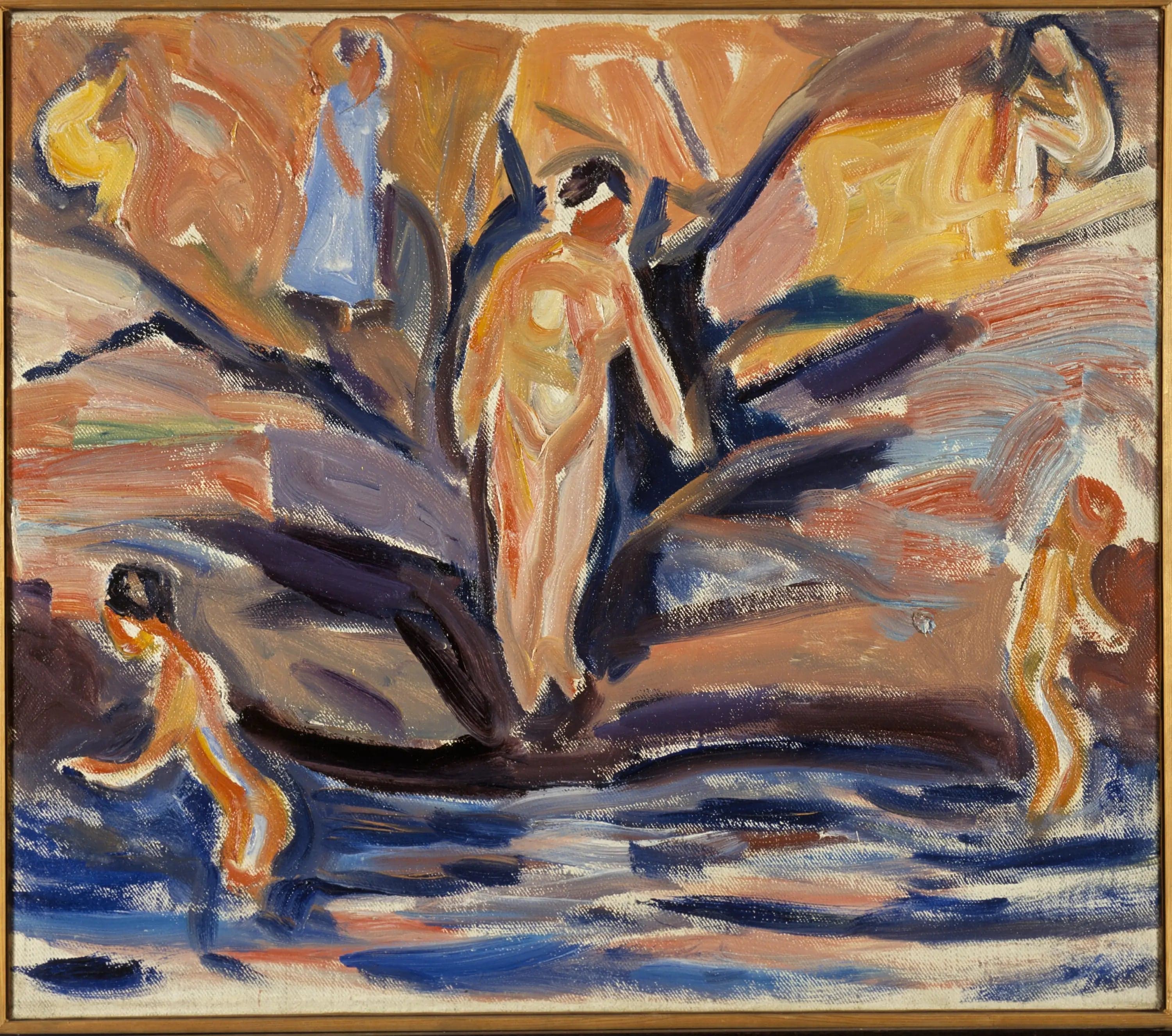
Women and Children Bathing
- Original dimensions
- 64 x 55 cm
- Museum
- Munch Museum
- Year
- 1914
Scene depicted
In this canvas , Munch immerses us in a family moment, a moment of joy and communion with nature. The bathing women and children convey a contagious lightness, harmoniously surrounded by a natural setting that evokes peace and serenity. This pictorial work is an ode to life, to the simplicity of shared moments, where each brushstroke seems to resonate with the laughter of children.
Historical context
Created in 1914 in the heart of Oslo, this painting is emblematic of the expressionist movement, dear to Edvard Munch . At a time when artistic advancements were disrupting conventions, this painting stands as an open window to human emotions. Currently exhibited at the Munch Museum, this canvas of 64 x 55 cm captures the essence of the human experience, both in its execution and inspiration.
Place in the artist's career
Women and Children Bathing represents a key stage in the career of Edvard Munch . This painting, the fruit of his creative maturity, is part of a period where his personal emotions take a predominant place. Like The Madonna and The Scream, this painting illustrates the transition to a more joyful form of expression, while remaining true to the essence of his deepest feelings.
Anecdote
“Nature is my best advisor, it reveals the depth of emotions.” These words from Edvard Munch resonate when thinking of the peaceful setting that gave birth to the masterpiece . Inspired by sunny swimming days, he was struck by the youthful beauty and harmony of bodies in motion, thus capturing innocence in the painting .