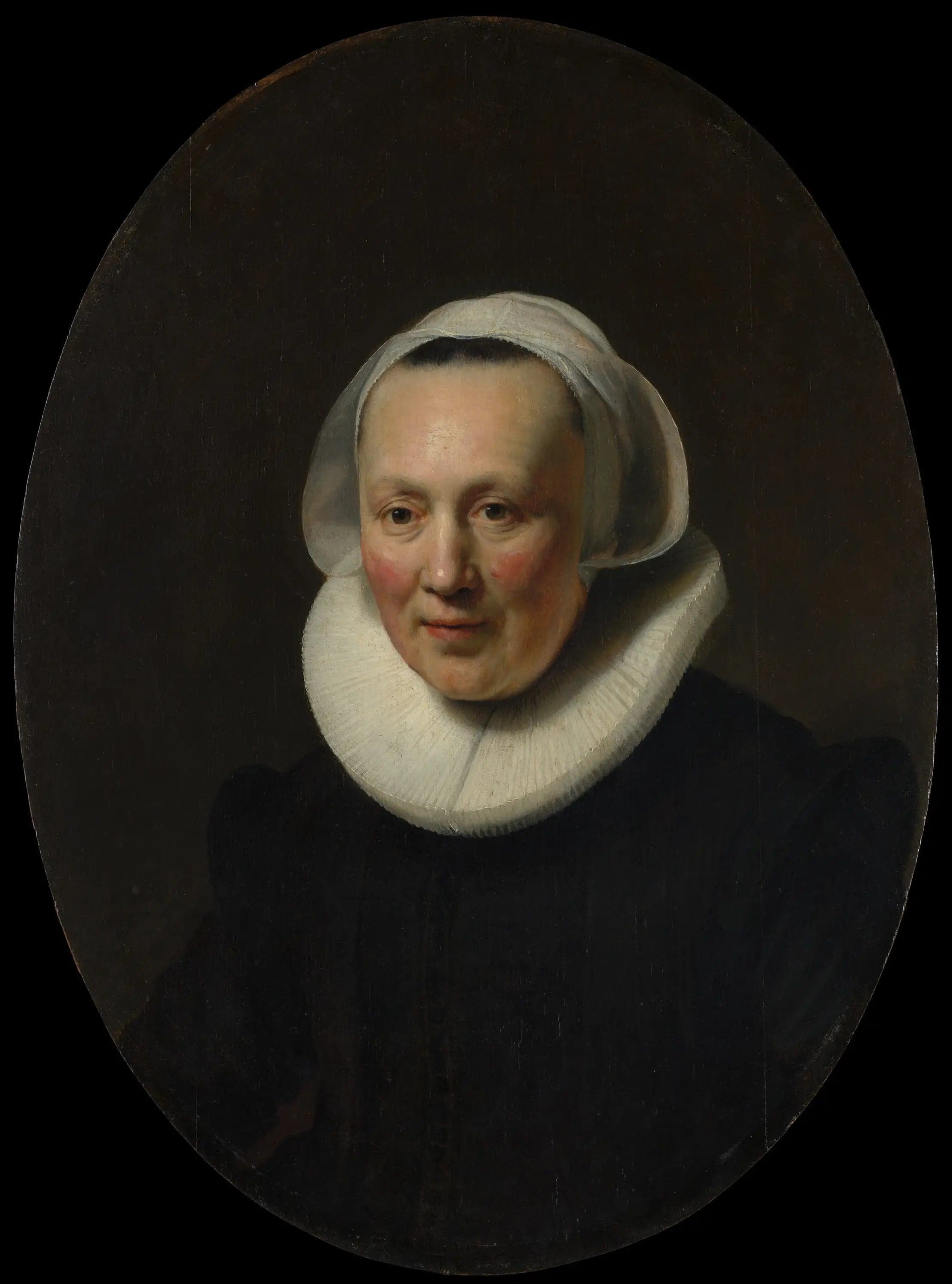
Woman's Portrait
- Original dimensions
- 50.2 x 67.9 cm
- Museum
- Metropolitan Museum of Art
- Year
- 1633
Scene depicted
This masterpiece testifies to the finesse of the portrait, where the woman depicted, with her penetrating gaze and delicate expression, seems ready to reveal her most intimate thoughts. The play of light enhances her features and evokes an atmosphere of mystery, creating a dialogue between the viewer and the subject. It is a work that explores the depth of the human soul through art.
Historical context
This magnificent painting was created in 1633, at the heart of the Dutch golden age, in Amsterdam, a city bustling with artistic and commercial activity. This masterpiece is an emblematic piece of the baroque movement, and it is currently displayed at the Metropolitan Museum of Art in New York. With dimensions of 50.2 x 67.9 cm, this canvas captivates the eye and the soul.
Place in the artist's career
Positioned at the peak of his career, Portrait of a Woman represents the technical and emotional mastery of Rembrandt . Compared to works such as "The Anatomy Lesson of Dr. Tulp" and "The Members of the St. Luke's Guild," this painting illustrates an evolution towards a deeper exploration of human psychology.
Anecdote
Rembrandt is said to have said: "The true beauty of a portrait lies in the spirit captured beyond the features." Imagine him, one spring morning, scrutinizing the face of a woman, his thoughts drifting between light and shadow. This fleeting moment gave birth to the evocative power of the painting , where each brushstroke tells a story.