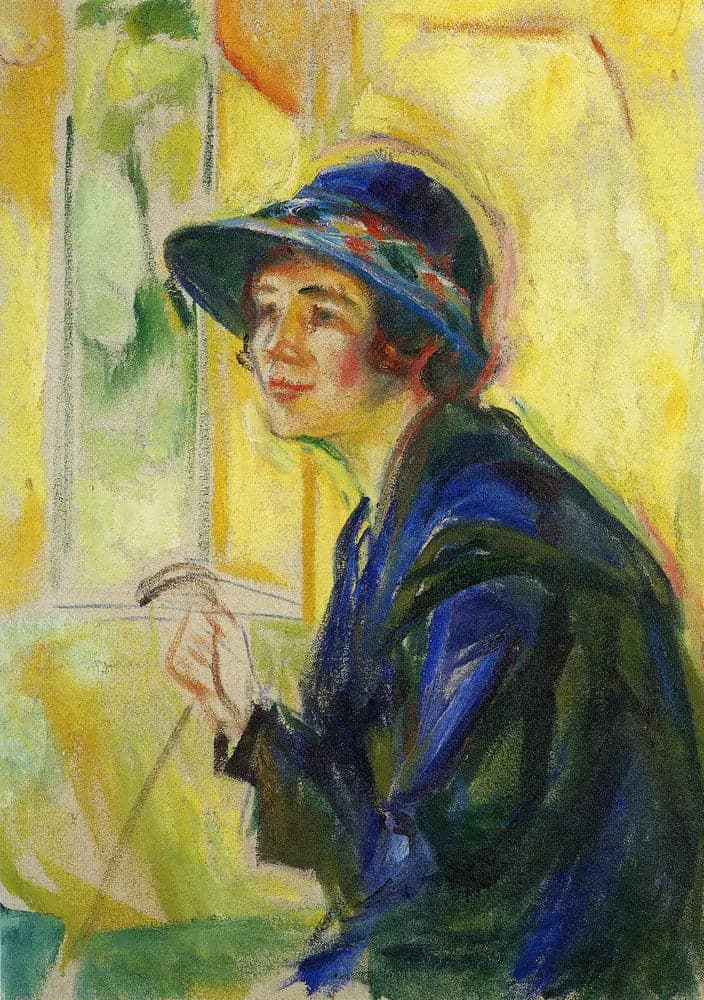
Woman's Portrait on a Yellow Background
- Original dimensions
- 70 x 99 cm
- Museum
- Not specified
- Year
- 1922
Scene depicted
The painting “Portrait de femme sur un fond jaune” is a celebration of emotions and human psychology. The woman depicted, enveloped in a bright yellow halo, evokes both sweetness and melancholy. Her gaze, both thoughtful and penetrating, seems to fix the observer, inviting them to dive deep into her thoughts. The bright background contrasts with the complexity of her expression, a palpable tension between the celebration of life and introspection. Thus, this canvas transports us beyond the visual, captivating the viewer in an emotional dialogue.
Historical context
Created in 1922, in the heart of Oslo, this painting is part of the expressionist movement, an emerging trend that seeks to translate emotions more than apparent reality. At that time, Munch, an iconic figure in art, transcends conventions and will leave an indelible mark on the world of modern art. Today, the canvas remains a powerful symbol of the inner quest and the representation of feelings.
Place in the artist's career
The portrait of a woman on a yellow background is situated at a turning point in Munch's career, marking a stylistic peak in his journey. In parallel with The Scream and The Madonna , this work shows both a technical and emotional evolution, where color and light become protagonists of his compositions. This painting expresses an artistic maturity where the distractions of the outside world blend into poignant introspection.
Anecdote
“I paint to immortalize emotions, the breath of life that passes.” These words of Edvard Munch resonate when thinking about the genesis of his masterpiece . Imagine a bright morning, the streets of Oslo bathed in golden light, when a female face, emerging from the everyday, captivated the artist's soul. This fleeting encounter translated into the vibrant intensity present in Portrait de femme sur un fond jaune .