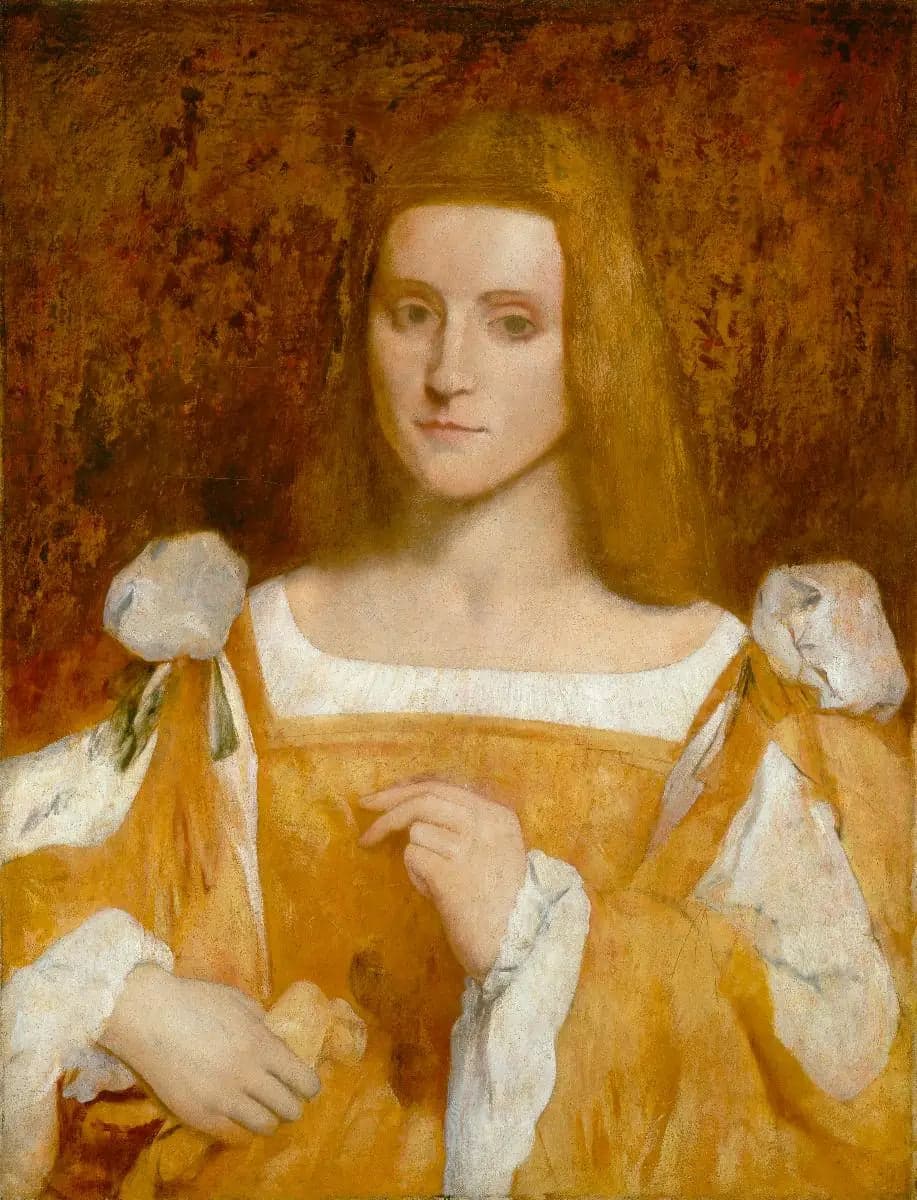
Woman's Portrait after Caroto
- Original dimensions
- 53 x 69 cm
- Museum
- Kunsthaus Zurich
- Year
- 1867
Scene depicted
The canvas offers a refined portrait of a woman, subtly evoking classical beauty through a modern reinterpretation. Her elegant posture, her evanescent gaze, as well as the use of light reveal a complex personality, playful yet also tinged with melancholy. This painting transports the viewer to an elegant Parisian evening, where refinement meets intimacy.
Historical context
Created in 1867, in a bustling Paris, this painting is at the heart of the Impressionist movement. The work resonates with a time when art evolved under the influence of great personalities such as Manet and Monet. Currently, this canvas is carefully preserved at the Kunsthaus Zurich , a radiant institution within the European art scene, and boasts remarkable dimensions of 53 x 69 cm.
Place in the artist's career
This canvas is situated at a turning point in Degas's career, between his exploration of ballet scenes and his captivating portraits. In parallel, works such as “The Dance Class” and “Woman in a Ballerina” testify to his transition from an academic style to a bolder approach, combining traditional techniques with modernity.
Anecdote
Edgar Degas stated: “Beauty hides where one least expects it.” Inspired during a walk, he crossed the gaze of a woman, bursting with mystery and grace. This fleeting moment gave birth to this masterpiece , a painting that captures the delicacy and essence of femininity.