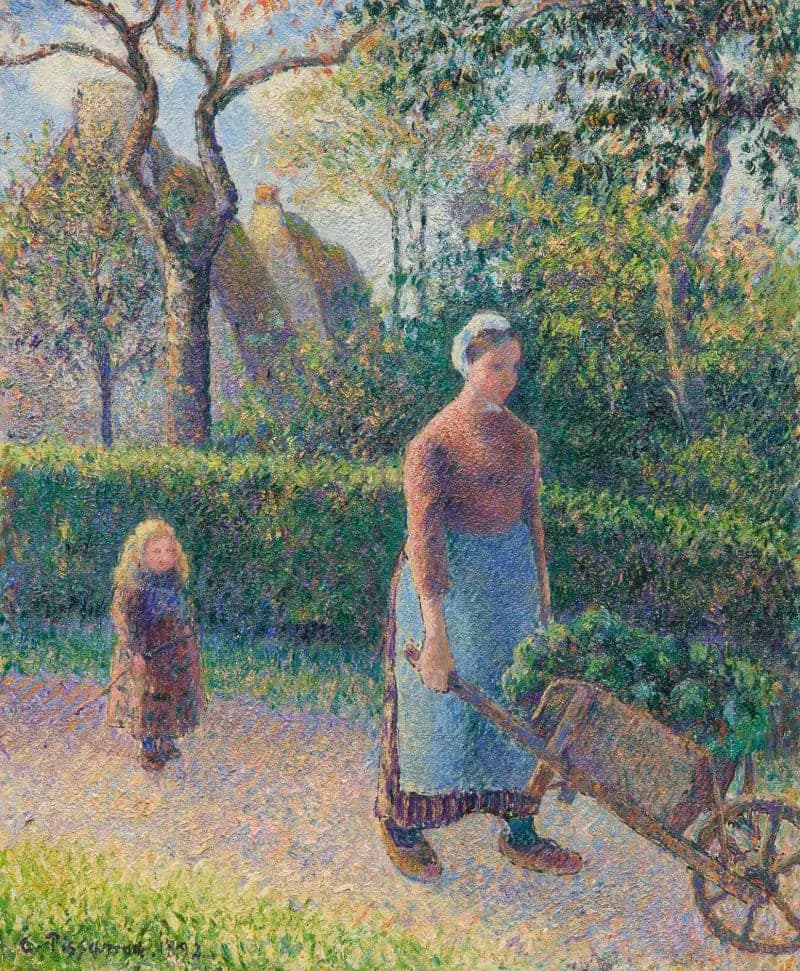
Woman with Wheelbarrow
- Original dimensions
- 38.5 x 46.3 cm
- Museum
- Not specified
- Year
- 1892
Scene depicted
The painting "Woman with Wheelbarrow" depicts a woman engaged in work, her silhouette gracefully outlined against a lush landscape. The painting captures the essence of a day of labor, where every detail contributes to the harmony of the composition. The vibrant colors and dynamic brushstrokes open a window to a bygone era, where every moment of simplicity was tinged with beauty.
Historical context
Created in 1892, in the fertile context of Impressionism , this painting is situated at the peak of Pissarro's work, an artist who marked the artistic scene of Paris and the surrounding countryside. The painting evokes rural life, highlighted by a bold technique where light dances on every brushstroke. Although its current location is not specified, the work resonates with the dimensions that bring it to life on the canvas.
Place in the artist's career
Positioned at the heart of Impressionist art, this canvas constitutes a crucial step in Pissarro's artistic quest. It is part of a period of maturation, where he distances himself from academic conventions while drawing inspiration from light and movement, as in his other paintings , such as "Garden at Éragny" and "Boulevard Montmartre, Night Effect".
Anecdote
"I have always sought to capture the very essence of life, even in the simplest moments." This quote from Pissarro recalls the moment of inspiration during a sunny morning, where he observed a woman pushing her wheelbarrow. It was entirely plausible that he recreated on his canvas the simplicity and dignity of everyday life, transforming the scene into an masterpiece evocative.