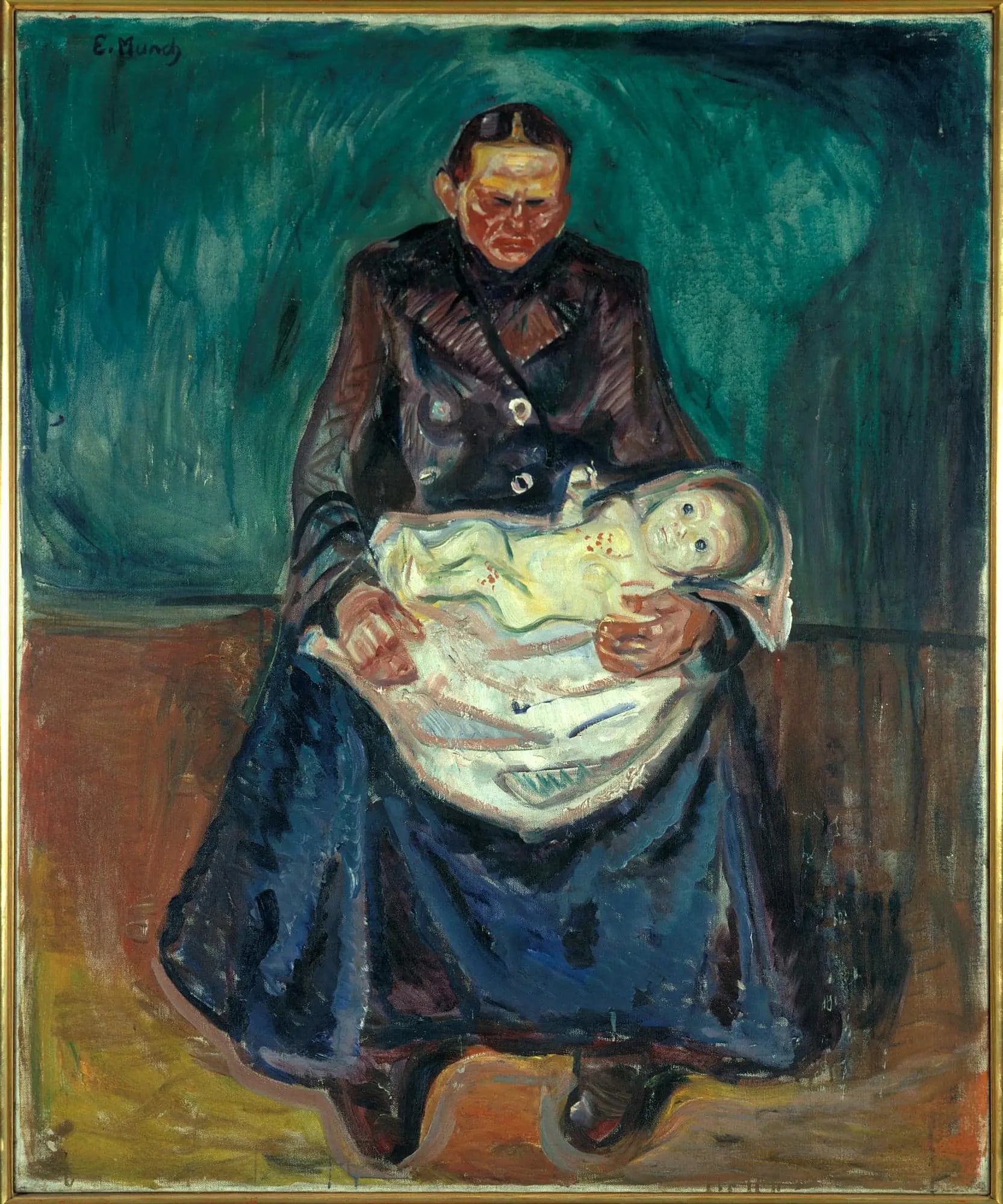
Woman with Sick Child. Heritage
- Original dimensions
- 100 x 120.5 cm
- Museum
- Munch Museum
- Year
- 1905
Scene depicted
This painting by Edvard Munch illustrates a poignant scene, depicting a mother at her wits' end, reaching out to her sick child. The composition evokes an atmosphere of despair, but also of unwavering love, capturing the very essence of motherhood and human vulnerability. Every glance, every gesture in this masterpiece is powerful, containing a visible narrative of fear, distress, and infinite affection.
Historical context
Created in 1905, in Oslo, Norway, Woman with Sick Child. Heritage is part of the expressionist movement, a trend that seeks to express emotion through distortion and color. In the freshness of this early 20th century, Munch draws inspiration from a changing society, while tapping into the turmoil of his own experiences. This canvas is today passionately preserved at the Munch Museum, where visitors can contemplate its captivating dimensions of 100 x 120.5 cm.
Place in the artist's career
Integrated into Munch's expressionist period, Woman with Sick Child. Heritage represents a turning point in his style, between his early works like The Scream and his later explorations of human relationships. This painting shows his transition to more intimate compositions, where the expression of human emotions becomes the center of his art.
Anecdote
In a moment of sincerity, Munch is said to have once remarked: “It is in suffering that one finds the essence of life.” Seeing a mother engulfed in sadness in the early hours of a misty morning, he captured this emotion in a painting filled with tenderness and pain. Woman with Sick Child. Heritage resonates with this emotional moment, inviting the viewer to feel the depth of the maternal bond.