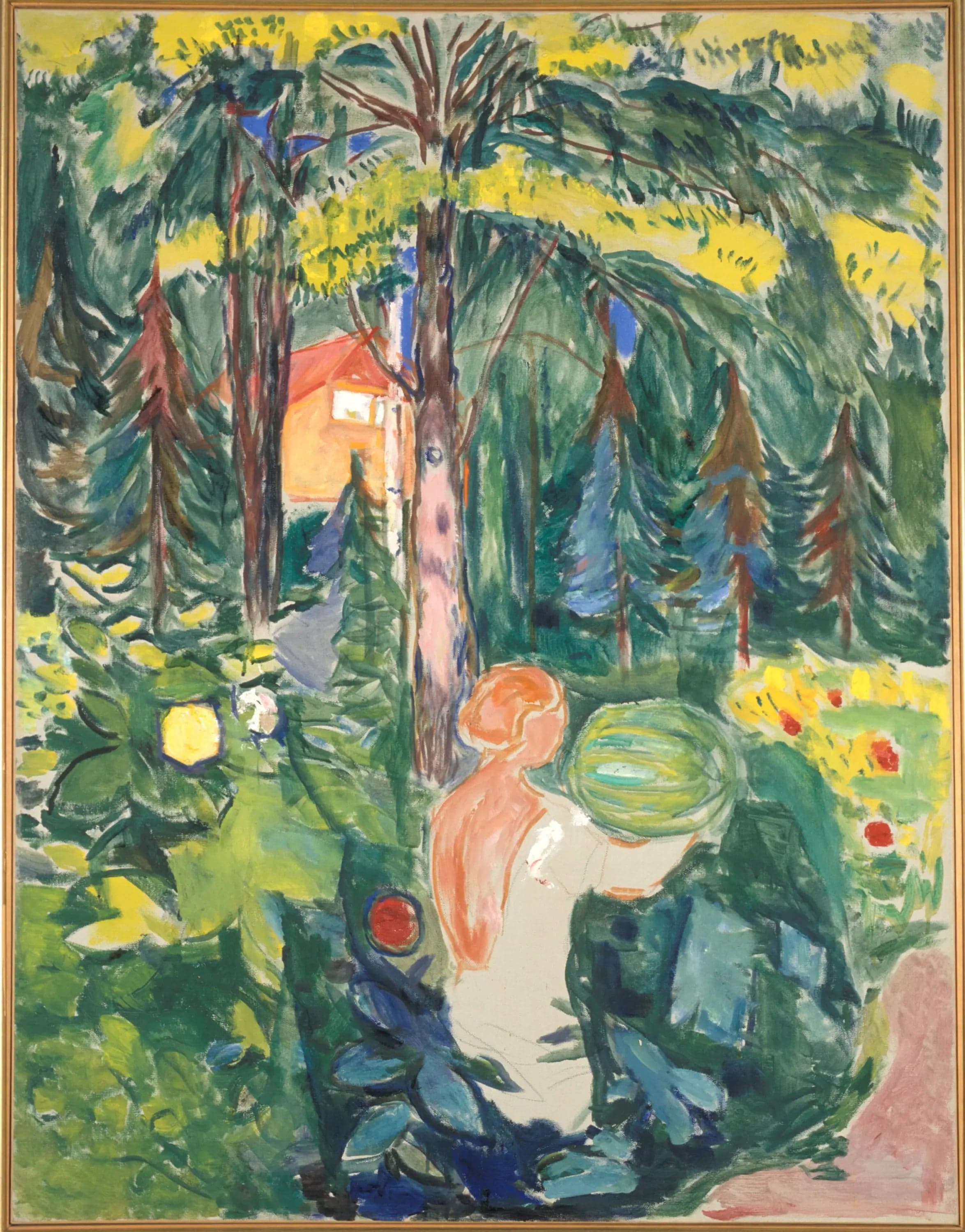
Woman with Pumpkin
- Original dimensions
- 100.5 x 130 cm
- Museum
- Munch Museum
- Year
- 1942
Scene depicted
In the painting , a woman stands serenely in silhouette, holding a pumpkin, a symbol of fertility and connection to the earth. The surrounding landscape, imbued with a mysterious atmosphere, evokes a silent dialogue between humanity and nature. The composition, with rich textures and play of light, invites exploration of the depths of the feminine soul, revealing an inner world as vast as the sky above.
Historical context
Created in 1942, this painting is emblematic of the expressionism movement, a rich artistic movement that flourished in Oslo, Norway. It was during this time, marked by various human upheavals, that Edvard Munch deeply immersed himself in emotions and psychoanalysis, thus capturing the essence of his time. Currently, the canvas is the pride of the Munch Museum where it is displayed alongside other fundamental works.
Place in the artist's career
The Woman with Pumpkin represents a pivotal period in Edvard Munch 's career. It fits into an artistic journey that ranges from the melancholy of The Scream to the tranquility of The Madonna , this canvas showcases a technical evolution, where Munch explores color and texture with increased maturity. It marks a stylistic peak in the artist's mature years.
Anecdote
Edvard Munch once stated: "Every work of art is a struggle between what we want to show and what we fear to show." Such was the case during the creation of the Woman with Pumpkin . Inspired by a misty morning over his garden, a simple moment of contemplation led to the birth of this masterpiece , where each brushstroke tells a story of solitude and nature.
Major exhibitions
Munch og Ekely: 1916-1944