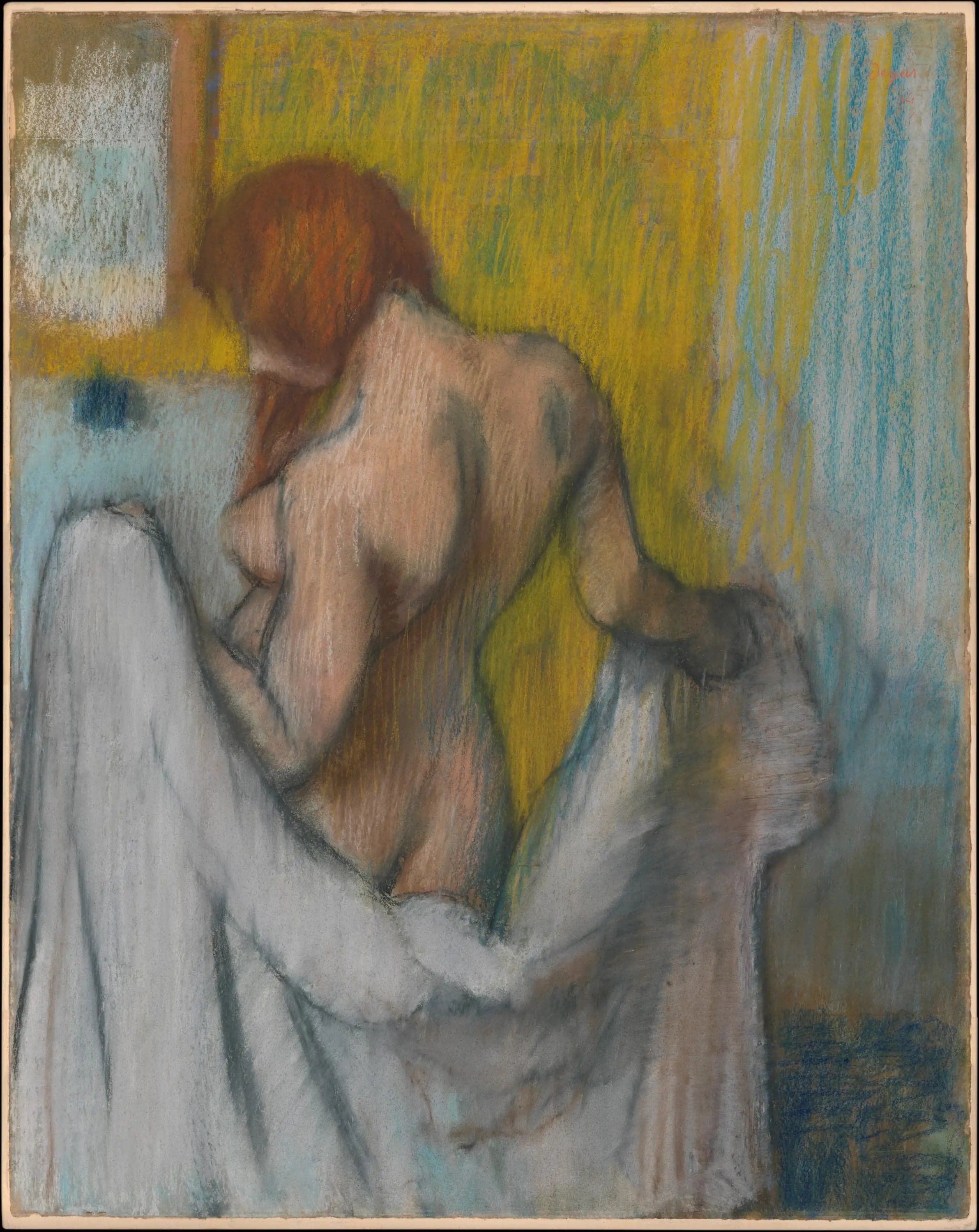
Woman with a Towel
- Original dimensions
- 76.2 x 95.9 cm
- Museum
- Metropolitan Museum of Art
- Year
- 1896
Scene depicted
In this pictorial work, Degas captures a young woman, enveloped in light, holding a towel, indicating a moment of transition and intimacy. The subtle lighting plays on her forms, highlighting the texture and fluidity of the drapery. This painting conveys a natural elegance while suggesting the intimate, a fleeting glimpse into the daily lives of women of his time.
Historical context
This painting , created in 1896, is set in the vibrant context of the Belle Époque in Paris, a period of artistic effervescence where the Impressionist movement was redefining the contours of art. The painting is currently housed at the Metropolitan Museum of Art , a cultural landmark in New York, where it testifies to the indelible legacy of Edgar Degas and his commitment to representing everyday life.
Place in the artist's career
Woman with a Towel is positioned at an advanced stage of Degas's career, as he fully masters his technique. He dialogues with other works such as The Dance Class and The Café-Concert , illustrating a stylistic evolution towards a deeper exploration of forms and textures, while maintaining a powerful connection to modern life.
Anecdote
Degas once shared: “The beauty of a work lies in its ability to capture an ephemeral moment.” Woman with a Towel is such a moment, where light filters through the canvas, revealing the fragile grace of a woman taking a moment of solitude, a scene captured on a quiet morning, imbued with nostalgic tenderness.