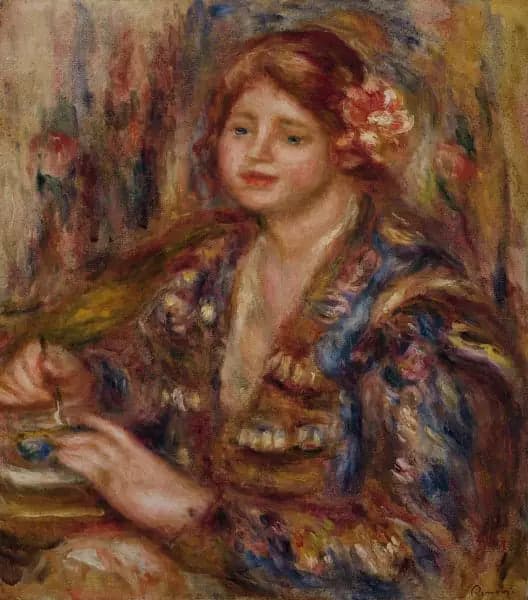
Woman with a Rose - Pierre
- Original dimensions
- 46.4 x 52.4 cm
- Museum
- National Museum of Western Art
- Year
- 1910
Scene depicted
In "Woman with a Rose," Renoir offers us a vibrant scene of life. The female silhouette, surrounded by a halo of light, delicately holds a rose, a symbol of ephemeral beauty. The painting captures not only the elegance of its model but also the softness of an intimate atmosphere, filled with sensitivity and grace.
Historical context
Created in 1910, the painting "Woman with a Rose" by Pierre- Auguste Renoir is part of the Impressionist movement, redefining the artistic conventions of its time. This famous painting is displayed at the National Museum of Western Art in Tokyo, a remnant of the era when Renoir captured the fleeting beauty of everyday life with unparalleled delicacy.
Place in the artist's career
"Woman with a Rose" represents a key period in Renoir's career, illustrating his mature style at the crossroads of light and color. Compared to other paintings like "Luncheon of the Boating Party" and "Dance in the City," this painting shows a marked technical evolution characterized by a mastery of nuances and forms, testifying to the peak of his art.
Anecdote
"Every masterpiece is a window into the soul of a moment." This quote from Renoir evokes the inspiration that arose at the sight of a delicate woman, strolling with a rose. It was a spring morning, where the sweet song of birds and the scent of flowers intertwined, bringing the canvas to life and infusing an emotional strength that resonates even today.