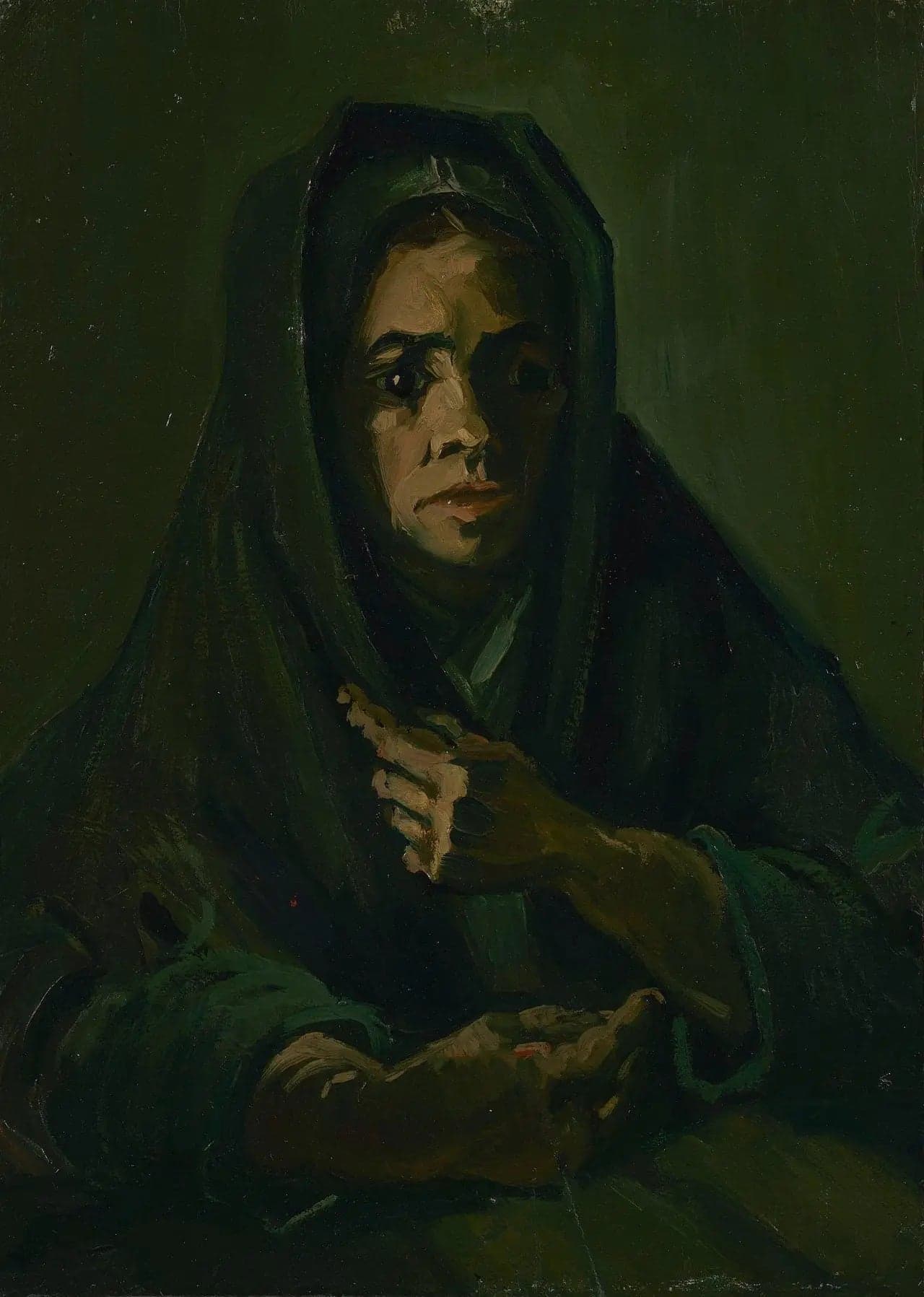
Woman with a Mourning Shawl
- Original dimensions
- 33 x 45.5 cm
- Museum
- Van Gogh Museum
- Year
- 1885
Scene depicted
The painting “Woman with Mourning Shawl” depicts a mysterious woman, wrapped in a dark shawl, who seems to bear the weight of sorrows and melancholies. Her gaze, poignant and deep, invites contemplation, while the shadows and lights in the composition reveal the psychological sensitivity of the artist. This moment of silence shared between the protagonist and the viewer is central to the pictorial narrative of this work.
Historical context
It was in 1885, in Nuenen , in the heart of the Netherlands, that Vincent van Gogh created this iconic painting. Made during the height of the post-impressionist period, this painting is part of an artistic approach sensitive to human emotions and the representation of everyday life. Today, the work is displayed at the Van Gogh Museum in Amsterdam, where it attracts the admiration of visitors for its depth and authenticity.
Place in the artist's career
This painting is situated in a pivotal phase of van Gogh's career, marking a maturity in his technique and emotion. Positioned between works such as “ The Potato Eaters ” and “ The Starry Night ”, Woman with Mourning Shawl reflects an evolution towards a more personal expression of feelings. The psychological depth of this canvas reveals the genius of the artist, transforming ordinary moments into vibrant masterpieces.
Anecdote
Vincent van Gogh once declared: “I do not paint what I see, I paint what I feel.” This quote resonates particularly when observing Woman with Mourning Shawl. Imagine Vincent, on a sunny morning, inspired by the illuminated face of a mourning woman in a peaceful corner of Nuenen . This emotion, this fleeting moment, is now materialized in a work of unparalleled evocative power.