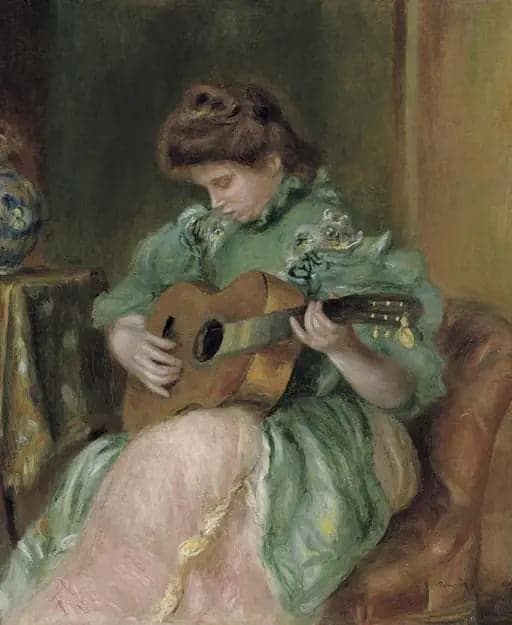
Woman with a Guitar - Pierre
- Original dimensions
- 53.5 x 65 cm
- Museum
- Not specified
- Year
- 1896
Scene depicted
Woman with a Guitar represents a rare intimacy, immortalizing a woman indulging in her musical passion. The delicate rendering of her face, as well as the artistic streak of colors, reveal the allure of feminine beauty and the escape offered by music. This painting perfectly illustrates the essence of joy, inviting the viewer into a melodious universe.
Historical context
This painting , created in 1896, is situated at the peak of the Belle Époque, a time when France experienced unprecedented cultural effervescence. Paris, an iconic city, was then the cradle of the Impressionist movement, of which Renoir is one of the leading figures. Although the current location of the work remains obscure, its presence in private collections attests to its eternal value.
Place in the artist's career
This painting marks a turning point in Renoir's career, fitting into a period of maturity where his artistic choices became clearer. Alongside Bal du Moulin de la Galette and La Grenouillère , “Woman with a Guitar” reveals the evolution of his style, oscillating from vibrant social scenes to a more intimate and personal exploration.
Anecdote
According to Renoir, each masterpiece is born from an unexpected encounter: “Music is a breath, just like painting. I simply captured a moment.” Imagine the painter, lifting his eyes from a sketch, observing a young woman with her guitar vibrating with harmony, inspired by the brilliance of a sunny morning, where the light gently caresses the notes of music.