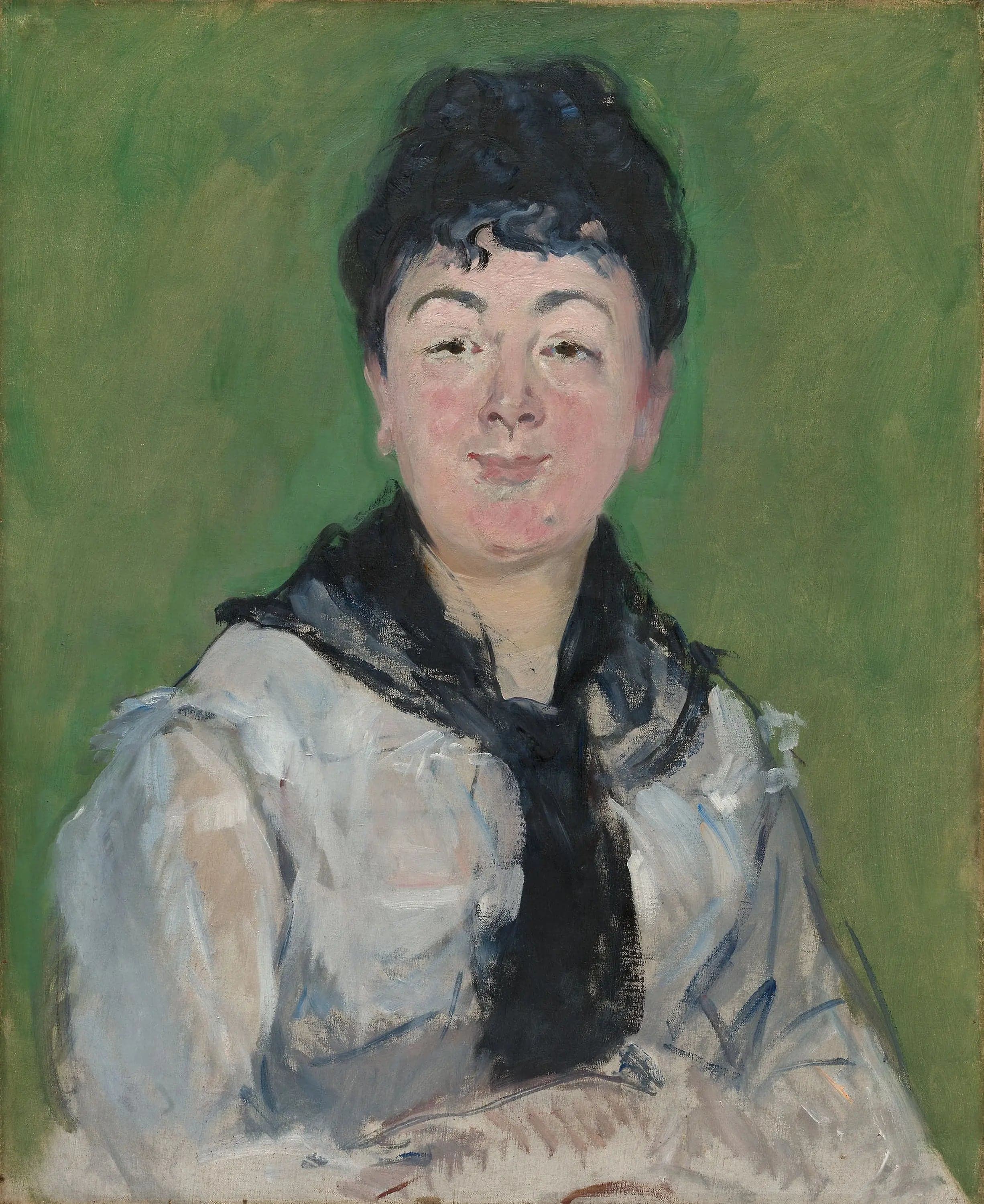
Woman with a Black Headscarf
- Original dimensions
- 50.5 x 61.5 cm
- Museum
- Art Institute of Chicago
- Year
- 1878
Scene depicted
The composition of “Woman with a Black Headscarf” depicts an elegant woman, her head slightly tilted, seeming to immerse herself in her thoughts. The black headscarf framing her face is both a protection and an invitation to discover her intimacy. This painting, through its nuances and play of shadows, raises questions about identity and femininity at the heart of 19th century Paris.
Historical context
Created in 1878, this painting is the result of an innovative mind located in Paris, within the Impressionist movement that opposed the academic conventions of the time. Édouard Manet , by capturing the ordinary beauty of a woman draped in a black headscarf, manages to elevate a fleeting moment while questioning the artistic norms of his time. Today, the painting rests elegantly within the Art Institute of Chicago , inviting visitors to admire it in all its magnificence.
Place in the artist's career
“Woman with a Black Headscarf” represents a crucial step in Manet's career, marking his period of maturity. In contrast to works such as “Luncheon on the Grass” and “Olympia,” this painting reveals a more introspective and lyrical approach, highlighting the artist's technical evolution and the affirmation of his unique vision.
Anecdote
In his words, Manet stated: “The painting should not seek to represent life, but to suggest it.” Thus, the inspiration for this masterpiece was born one winter morning, at the turn of an alley, where he crossed the gaze of a mystical woman, frozen in her headscarf. This fleeting moment was immortalized on the canvas , vibrating with authentic emotional intensity.