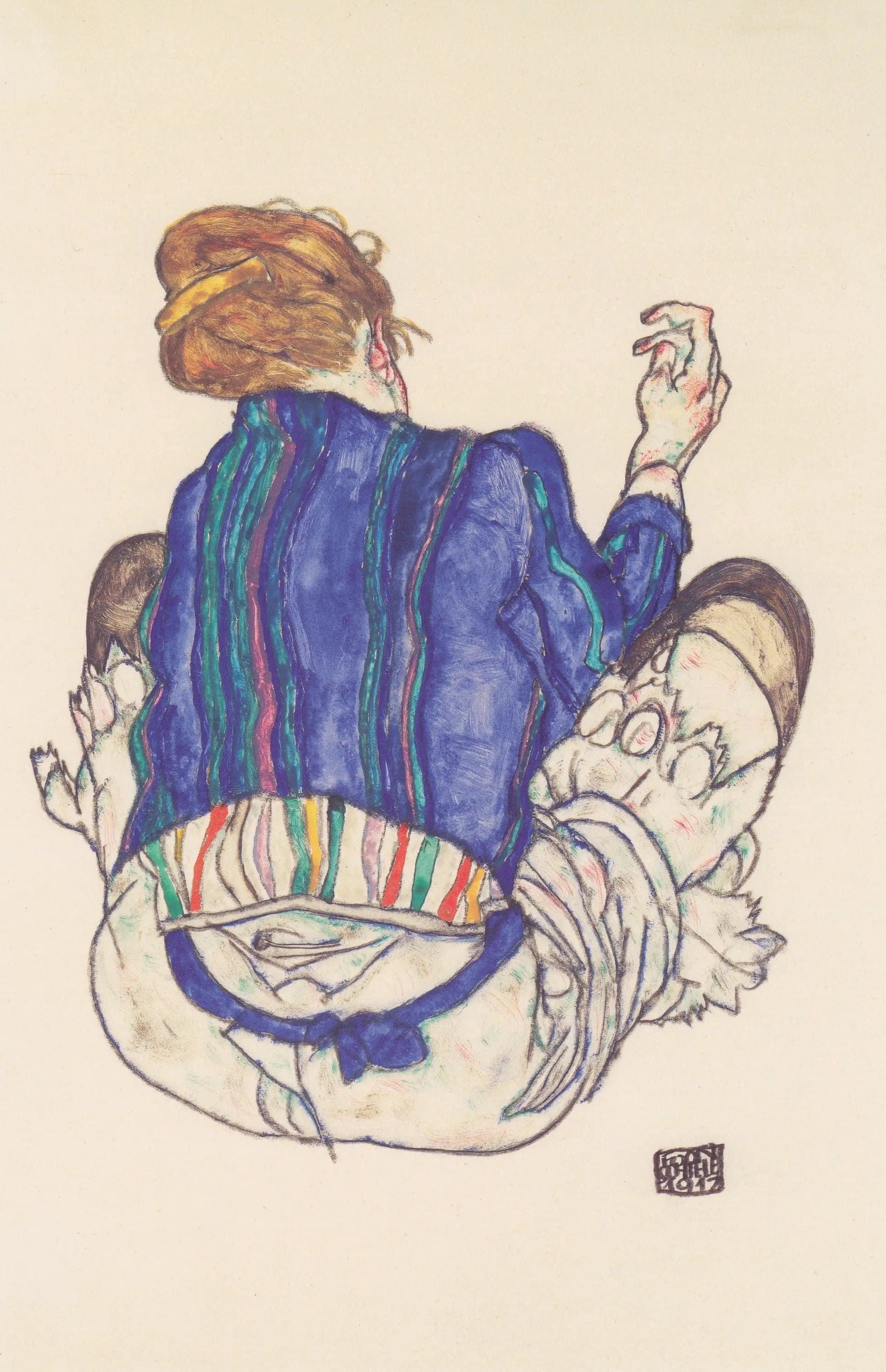
Woman Sitting, Seen from Behind
- Original dimensions
- 29.8 x 46.4 cm
- Museum
- Metropolitan Museum of Art
- Year
- 1917
Scene depicted
This canvas illustrates a woman sitting, turned towards the world but secretive in her introspection. The absence of her face enhances the mystery and opens the way for the viewer's imagination. Far from being a simple portrait, this pictorial work offers a dialogue between interiority and exteriority, highlighting the duality of the feminine being.
Historical context
Created in 1917, in the vibrant city of Vienna, this painting is part of the expressionist movement, an innovative movement that left an indelible mark on modern art. At that time, Vienna was bubbling with avant-garde ideas, where art reflects the tensions and emotions of a changing society. The canvas , now preserved at the Metropolitan Museum of Art , embodies the very essence of this tumultuous time and the artist's quest for identity. Its dimensions, 29.8 x 46.4 cm, make it an impactful work, both intimate and universal.
Place in the artist's career
Woman Sitting, Seen from Behind marks a turning point in Schiele's career. It testifies to remarkable artistic maturity, approaching his previous masterpiece, Self-Portrait with the Pierced Ear from 1912, while distinguishing itself from his more ardent composition, The Dance from 1915. Here, he experiments with a more sober approach, using shapes and lines to express a deep emotional complexity.
Anecdote
“Beauty lies in the revelation of the soul” Schiele might have said, as he sketched the figures around him. The inspiration for this masterpiece came to him one sunny morning, when, in the calm of a studio, he observed a woman with delicate forms and a free spirit. This fleeting moment of grace was imprinted on the canvas, making this painting a profound exploration of the human condition and femininity.