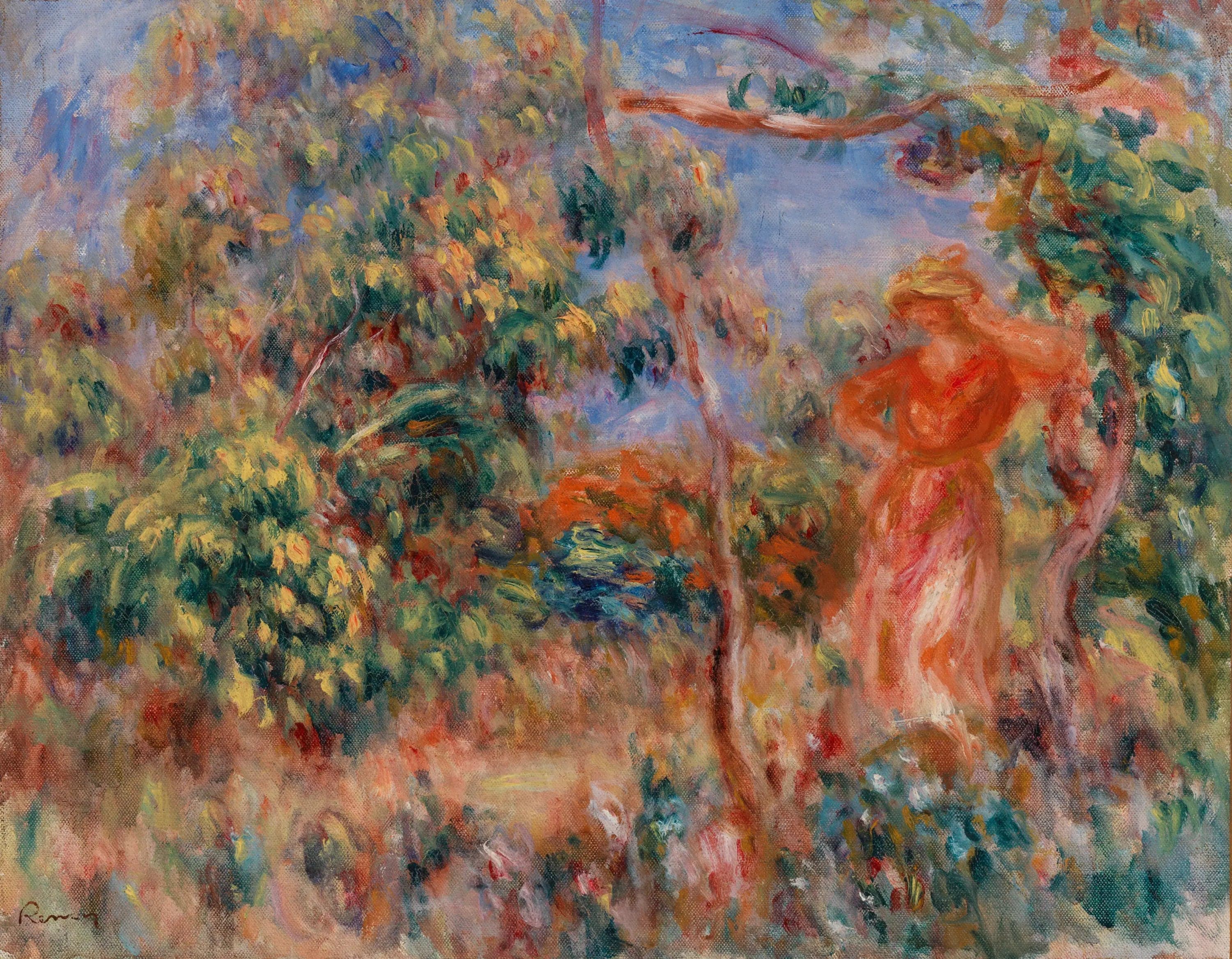
Woman in Red in a Landscape - Pierre
- Original dimensions
- 49.5 x 39.4 cm
- Museum
- Barnes Foundation
- Year
- 1917
Scene depicted
The scene depicted in this painting offers an insightful vision of a woman dressed in a vibrant red dress, seated in a lush landscape. The moving forms, bursts of light, and surrounding nature create a vibrant composition. The juxtaposition of the elegant silhouette against the serene background brings an almost poetic dimension, celebrating the beauty of the present moment.
Historical context
Created in 1917, at the crossroads of artistic paths during the vibrant Belle Époque, the painting "Woman in Red in a Landscape" by Pierre- Auguste Renoir represents the very essence of the Impressionist movement. Located in Philadelphia, the Barnes Foundation preserves this iconic work, thus capturing the legacy of one of the major figures of 20th-century French art. This masterpiece is a gateway to the light and colors of a bygone era.
Place in the artist's career
"Woman in Red in a Landscape" marks a turning point in Renoir's career, illustrating his transition to a more mature style. This work brilliantly stands alongside other paintings such as "Luncheon of the Boating Party" and "The Frog Pond," essential for understanding the evolution of his aesthetic approach. It is a celebration of life at a time when Impressionist art was flourishing.
Anecdote
Renoir once stated: "I love to paint women and light." This painting evokes a moment of serenity, as a gentle spring sun filters through the leaves, bathing the painting in golden light. The inspiration was born from a chance encounter in a garden, where the beauty of nature merges with feminine grace.