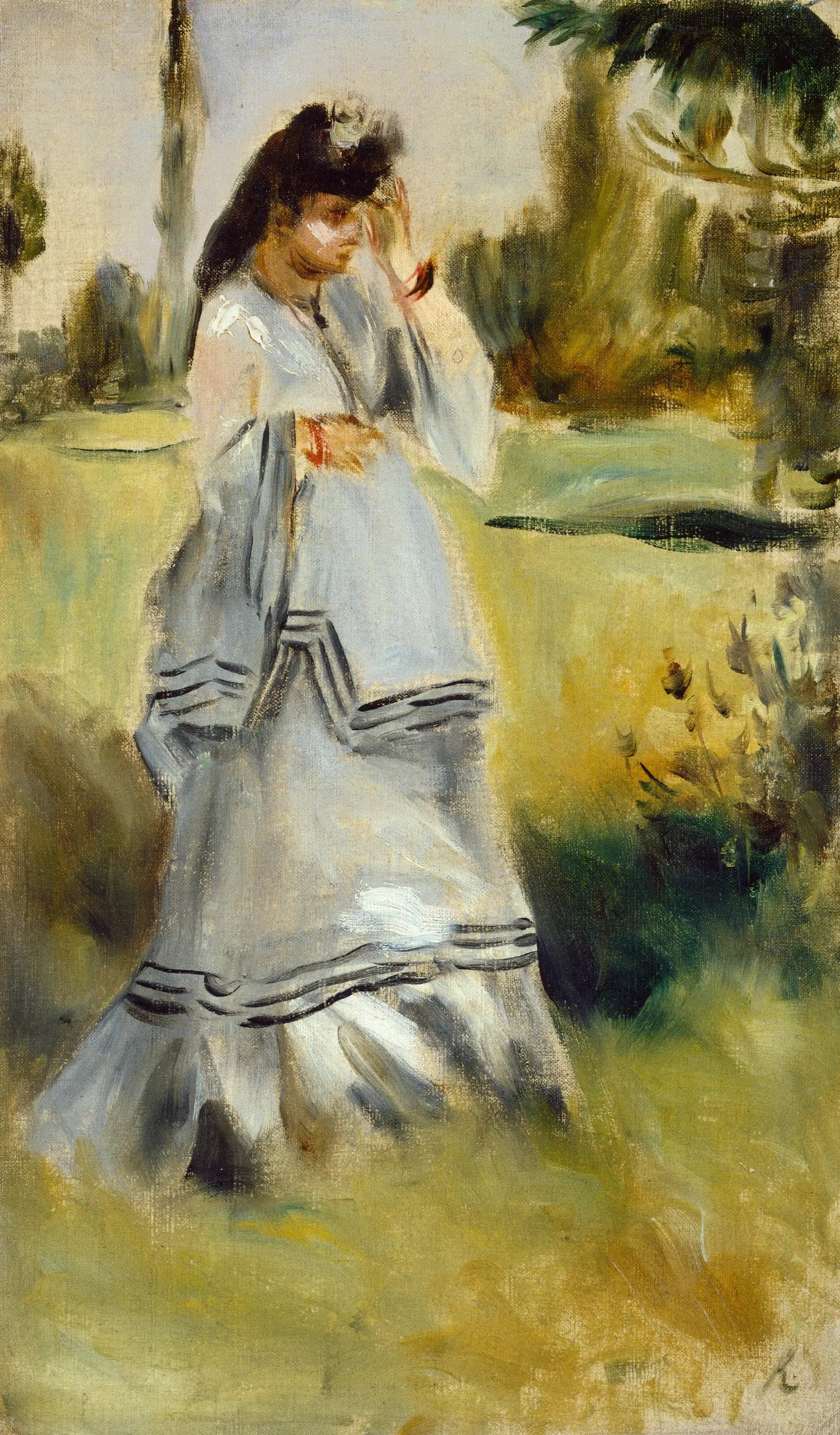
Woman in a Park - Pierre
- Original dimensions
- 16.1 x 26.1 cm
- Museum
- National Gallery of Art
- Year
- 1866
Scene depicted
In this delightful composition, Renoir depicts a woman sitting on a bench in a park, surrounded by vibrant greenery. Light filters through the foliage, creating plays of shadows and light, evoking a sense of serenity and calm. It is a frozen moment that invites contemplation, a moment where time seems to stop to savor the beauty of nature.
Historical context
Created in 1866 in Paris, this painting is situated in the heart of the Impressionist movement, an artistic current that sought to capture the light and ephemeral emotions of nature. The city, with its vibrant life and lush parks, serves as an ideal backdrop for this pictorial work . The canvas , now preserved at the National Gallery of Art , testifies to Renoir's early talent during a time marked by significant artistic developments.
Place in the artist's career
Woman in a Park represents a turning point in Renoir's career, marking the emergence of his Impressionist style. Positioned among other notable paintings such as Luncheon of the Boating Party and Dance in the City, this painting shows the evolution of his technique, from his early attempts to a brilliant mastery, where light and color become the true subjects of his art.
Anecdote
“Beauty hides in every ray of sunshine, every smile, every blade of grass.” These words, imbued with wisdom, summarize the inspiration that led Renoir to capture the fleeting moment represented by this canvas . Imagine a spring morning, the scents of blooming flowers in the air, and an elegant woman strolling, embodying the lightness and sweetness of a peaceful day.