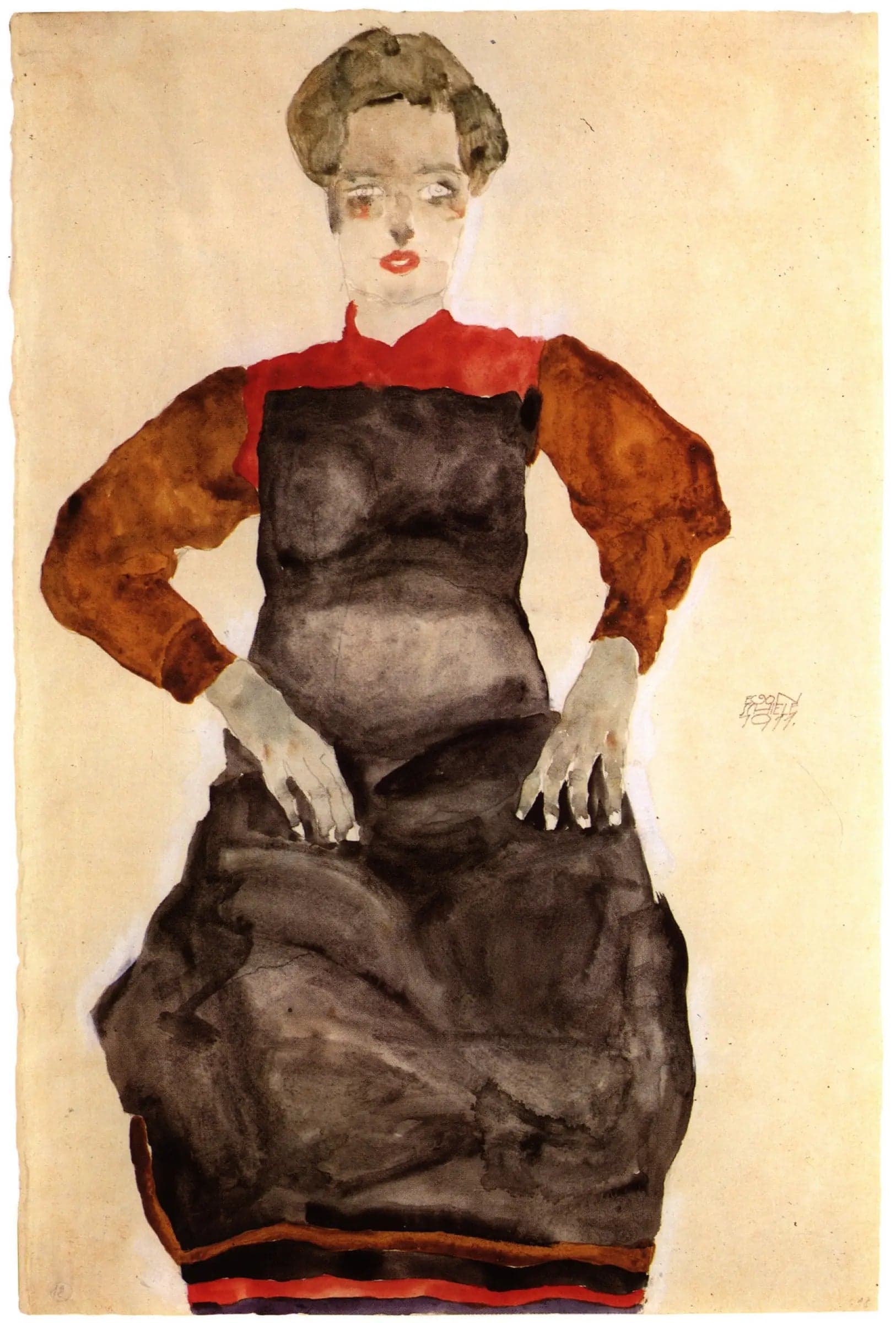
Woman in a Black Apron
- Original dimensions
- 32.2 x 48.5 cm
- Museum
- Not specified
- Year
- 1911
Scene depicted
In Woman in Black Apron , Schiele captures the essence of a confident female figure, confined within the space of her home. The black apron, a symbol of both protection and submission, imparts a duality to the canvas . Through this striking representation, the artist emphasizes the raw beauty of everyday life while immersing the viewer in her inner world.
Historical context
Created in 1911, this painting emerges in the vibrant context of Vienna, the capital of the Austro-Hungarian Empire. At the heart of the expressionist movement, Schiele's canvas embodies a period when art breaks free from realistic representation to explore the depths of the human psyche. Although its current location is not specified, this composition is meticulously preserved in private collections. Its dimensions, 32.2 x 48.5 cm, make it a pictorial work that draws the eye while preserving the intimacy of its subject.
Place in the artist's career
This canvas marks a turning point in Schiele's career, reflecting his stylistic maturity. Compared to his earlier works like Self-Portrait and The Mother , Woman in Black Apron employs bolder lines and a richer color palette. This masterpiece signifies the culmination of an aesthetic quest that questions and sublimates the body in existential angst.
Anecdote
"The painting must not only represent reality but transcend and reveal it." This quote, inspired by the essence of Schiele, evokes a spring morning when, in a Viennese café bathed in light, the artist captures the expression of a woman at rest, dressed in a simple black apron. This scene, imbued with delicate vulnerability, then transforms into a masterpiece where each brushstroke resonates with emotion.