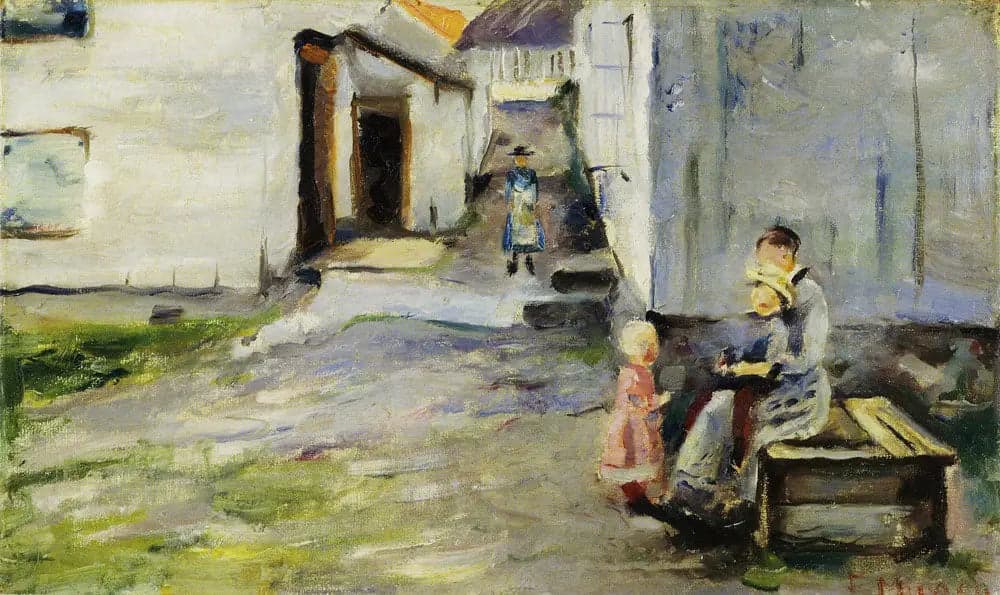
Woman and Children in Arendal
- Original dimensions
- 52 x 31 cm
- Museum
- Not specified
- Year
- 1886
Scene depicted
This canvas reveals an intimate scene of family life, where a mother seems to guide her child while exchanging a knowing glance with what could be her other child. The composition, both simple and poignant, enhances the beauty of human relationships, testifying to the unbreakable bond that unites generations. Under the soft light of the Norwegian sun, this painting resonates with an emotional depth that transcends time.
Historical context
Created in 1886, this painting takes place in the vibrant history of Arendal, a coastal town in Norway, then at the heart of the artistic transformations of the Symbolist movement. Emerging from a time when art asserts itself as a reflection of individual emotions and social struggles, the canvas explores human sensitivity through emblematic figures. Currently, this canvas is not found in a public museum, making each reproduction all the more precious.
Place in the artist's career
Woman and Children in Arendal is situated at the promising beginnings of Edvard Munch 's career. It foreshadows his bold style by integrating elements of daily life while exuding a deeply emotional atmosphere. At this time, Munch begins to explore recurring themes found in his other major works such as "The Scream" and "Madonna," where life and death intertwine inextricably.
Anecdote
“Every woman and child I met in Arendal was a living poem.” This quote perfectly summarizes the essence of a sunny morning, where the fresh air was filled with the sounds of waves and children's laughter. It is in this idyllic setting that Edvard Munch drew his inspiration, capturing the innocence and tenderness of a scene from daily life in Woman and Children in Arendal .