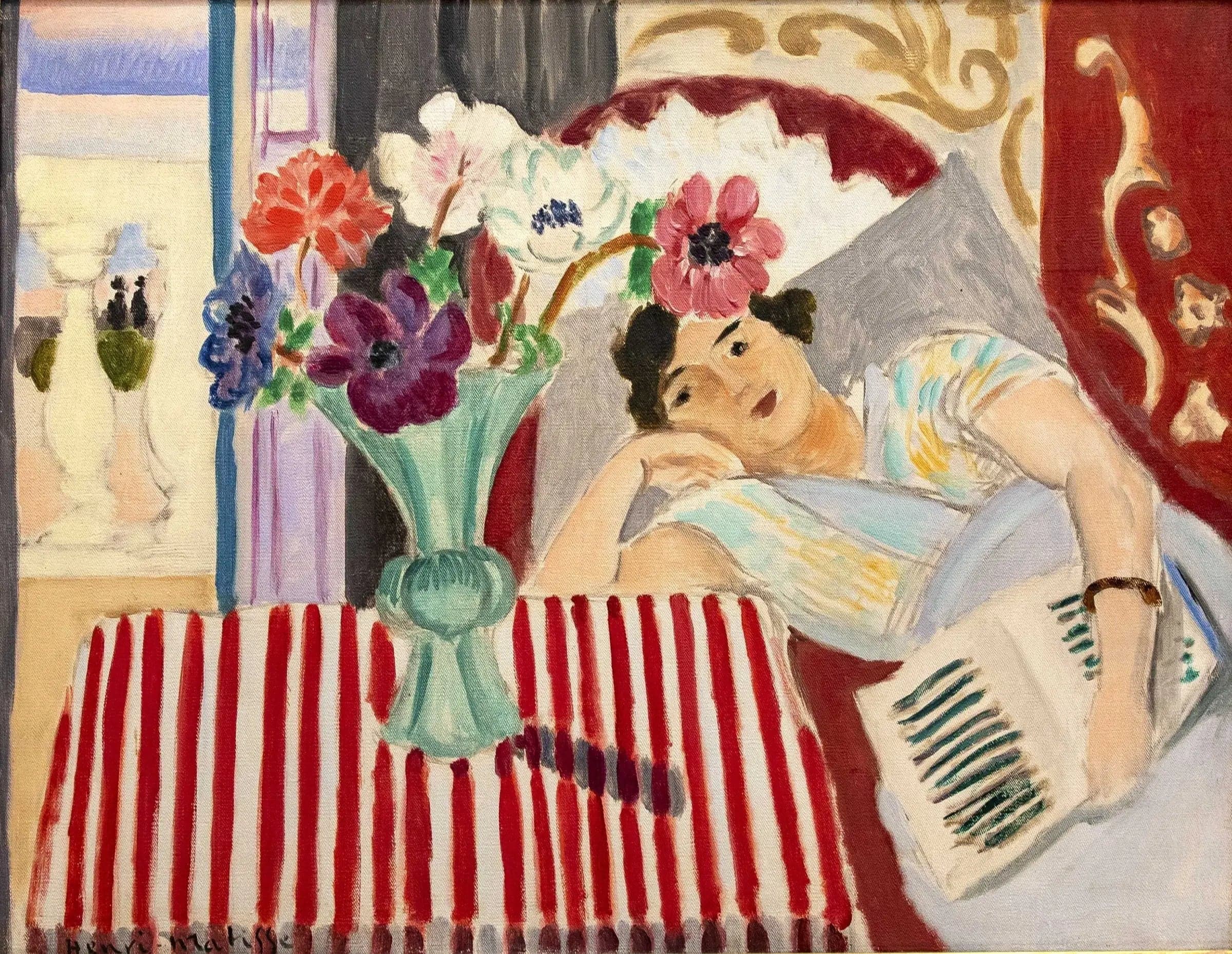
Woman and Anemones
- Original dimensions
- 98.8 x 78.7 cm
- Museum
- Agnelli Pinacoteca
- Year
- 1921
Scene depicted
In this painting , Matisse presents an elegant woman echoing the surrounding nature, her fluid forms contrasting with the brightness of the anemones. The painting exudes an intimate atmosphere, where each color tells a story, each shadow reveals an emotion. A vibrant composition, capturing both the softness and strength of femininity.
Historical context
Created in 1921, in the heart of vibrant Nice, this painting is part of the Fauvist movement, where bright color and bold form come together to bring to life an incomparable pictorial work. As the first rays of spring caressed the Côte d'Azur, Matisse immortalizes a scene imbued with harmony, currently exhibited in the Agnelli Pinacoteca.
Place in the artist's career
Woman and Anemones stands as a milestone in Matisse's career, symbolizing his period of artistic maturation. Alongside The Dance (1910) and The Joy of Life (1905), this canvas testifies to an evolution towards a freer and bolder abstraction, where color becomes the language of emotion.
Anecdote
When Matisse declared: "Painting is not a reproduction of reality, but a means of evoking sensations," he captured the very essence of his canvas . Inspired by a tranquil morning, he sketches his ideas as he observes the fragile beauty of the anemones in a vase, the light dancing around their delicacy.