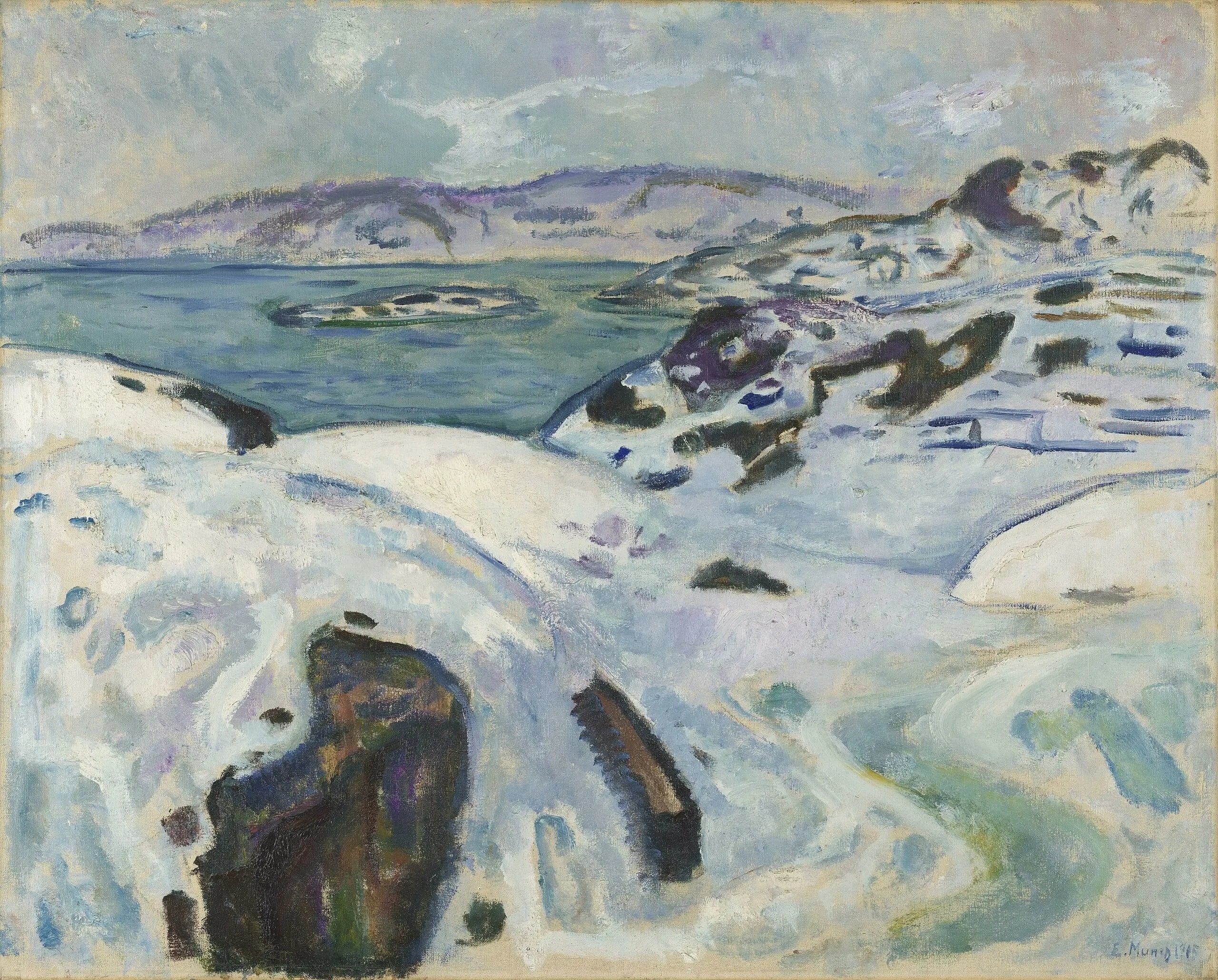
Winter on the Coast
- Original dimensions
- 173.4 x 139.1 cm
- Museum
- Harvard Art Museums
- Year
- 1915
Scene depicted
In Winter on the Coast , Munch captures the magic of winter landscapes, where misty skies stretch as far as the eye can see, enveloping the viewer in an atmosphere of melancholy. The silhouettes of bare trees and shades of gray blend to create a space that is both open and confined, inviting deep introspection. This painting echoes the fragility of human existence, under the gaze of untamed elements.
Historical context
Created in 1915, during a period marked by the turmoil of World War I, this canvas embodies its source in the Norwegian coastal landscapes, a region imbued with mystery and beauty. Affiliated with the expressionist movement, Winter on the Coast represents a poignant reflection on solitude and the human soul. Today, this painting captivates in the galleries of the Harvard Art Museums , testifying to Munch's indelible impact on contemporary art.
Place in the artist's career
Winter on the Coast represents one of the masterpieces of Munch's artistic maturity, where his themes of anguish and isolation are skillfully intertwined. This moment in his career can be put into perspective with other iconic creations such as The Scream and The Madonna , revealing both technical and emotional evolution over the years where the painting becomes a mirror of inner turmoil.
Anecdote
“Art must be an expression, an emotion, and not just a mere reflection of reality,” said Munch, thus evoking the genesis of his masterpiece . Inspired by a frosty morning on the Norwegian coast, this painting was born from a moment of contemplation, of intense feelings in the face of wild nature and changing skies, whose raw energy resonates in every brushstroke of this canvas .