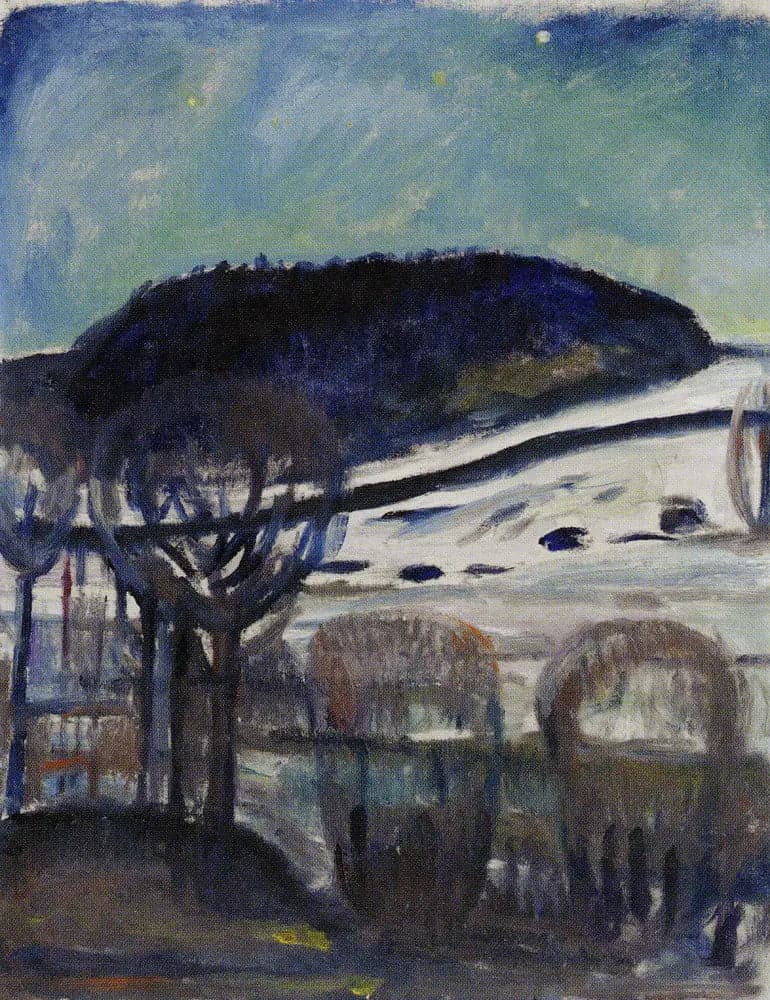
Winter Night
- Original dimensions
- 49.5 x 73 cm
- Museum
- Munch Museum
- Year
- 1900
Scene depicted
The canvas “Winter Night” depicts a nocturnal landscape, where a dark sky dominates, sprinkled with soothing shades of blues and blacks. In this enigmatic universe, silhouettes emerge, creating a mysterious atmosphere imbued with solitude. Munch, as a master of Expressionism , invites us to feel the silence and depth of the night, where each star seems to whisper the secrets of an intimately shared world.
Historical context
Created in 1900, this iconic painting emerges in the cultural context of Norway, more specifically in Oslo, at the heart of a burgeoning Symbolist movement. The canvas, currently displayed at the Munch Museum, reveals the torments and reflections of its creator, a work that immerses the viewer in the nuances of the human condition.
Place in the artist's career
Winter Night occupies a pivotal place in Munch's career, symbolizing a period of artistic maturity. Alongside “The Scream” and “The Madonna,” this canvas reflects a stylistic evolution marked by a deeper exploration of human emotions. Each painting, while distinct, is part of a common quest for the expression of inner turmoil.
Anecdote
“The night is a sea of solitude.” This quote from Edvard Munch evokes the precise moment of inspiration that brought his masterpiece to life. The artist, contemplating the enveloping darkness of a Scandinavian winter, captured the melancholy and emotional intensity, transforming his vision into a vibrant composition. Thus, Winter Night becomes a reflection of a tormented soul, a delicate beauty residing in the depths of black and blues.