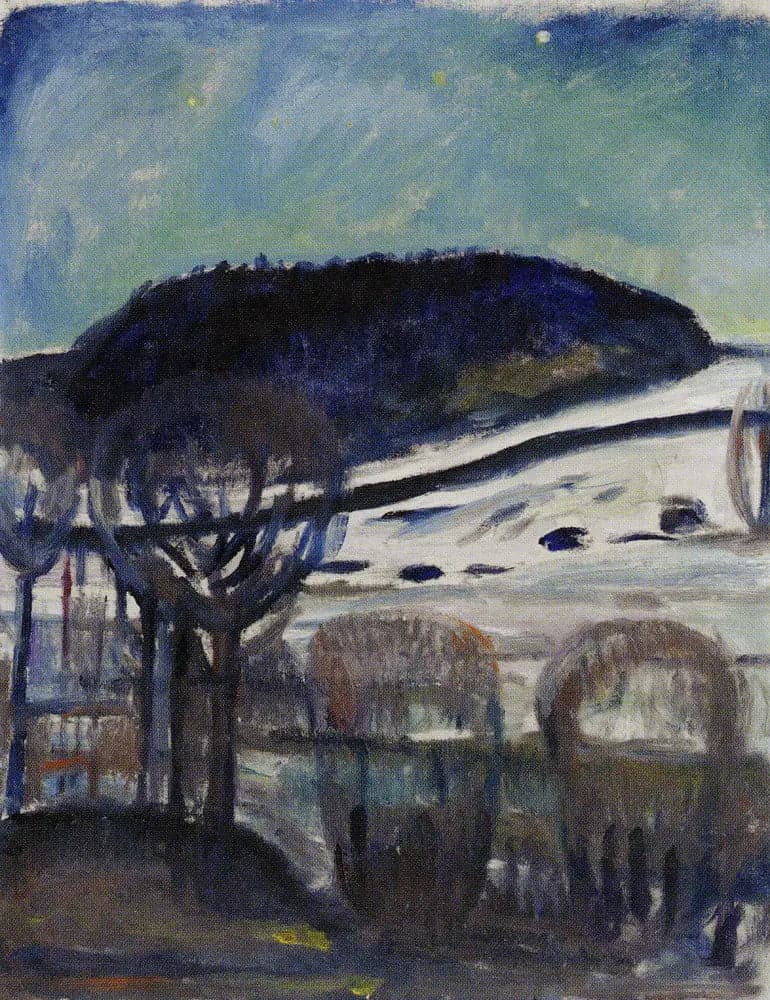
Winter Night
- Original dimensions
- 121 x 81 cm
- Museum
- Kunsthaus Zurich
- Year
- 1900
Scene depicted
This canvas illustrates a winter landscape of poignant beauty. The painting immerses us in a cold night, where the blizzard fades before a benevolent moon that gently illuminates the roofs of houses and the bare trees. One feels the tranquility disturbed by the breath of the wind, echoing buried thoughts and dreams. The atmosphere, both serene and unsettling, captivates and transports each viewer into an intimate contemplation.
Historical context
Created at the turn of the 20th century, in the vibrant city of Oslo, Winter Night is at the heart of the expressionist movement. This canvas , currently displayed at the Kunsthaus Zurich , evokes the melancholy and beauty of Scandinavian winters, through an atmosphere where the dance of shadows and lights shapes the landscape. The majestic dimensions of this painting reflect an era when art sought to transcend reality.
Place in the artist's career
Winter Night represents a significant transition in Munch's career, symbolizing his blossoming towards a more radical style. Compared to other paintings like The Scream , which exhumed human suffering, and The Madonna , where passion merges with tragedy, this pictorial work reveals a contemplative dimension, thus testifying to the rich and complex evolution of its creator.
Anecdote
Edvard Munch often said: “Art should not be beautiful, it should be sincere.” It was in a silent alley, bathed in the light of a snowy morning, that he found inspiration for his masterpiece . This quote resonates powerfully in the evocative strength of Winter Night , where each brushstroke tells a story of authenticity and emotion.