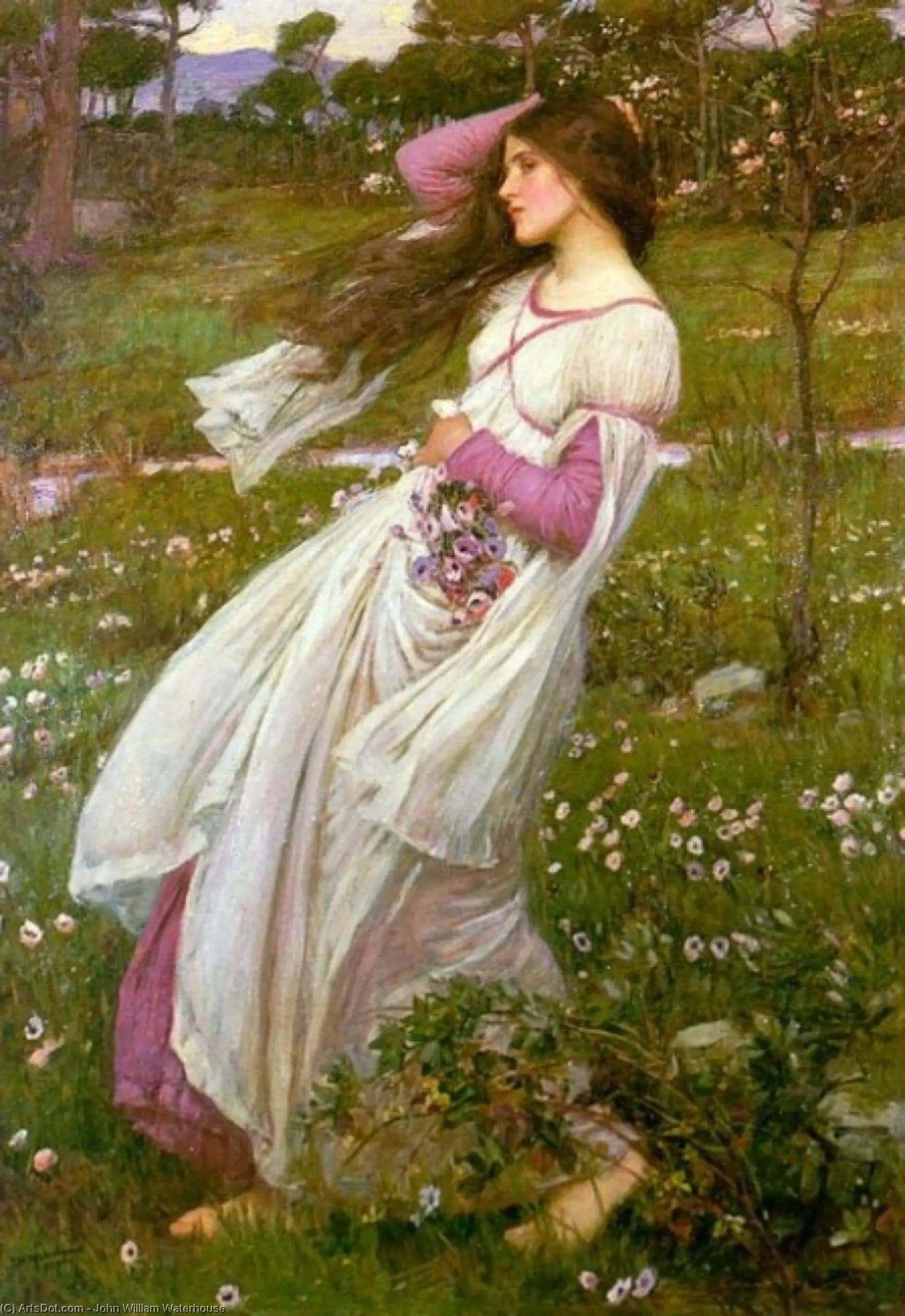
Windswept
Scene depicted
In this vibrant composition, an elegant woman is swept away by the currents of the wind, her delicate drapery dancing around her. The work captures a fleeting moment, a timeless escape into the unknown, where nature and the human spirit meet in sublime harmony.
Historical context
Created in 1900, this painting emblematic of John William Waterhouse is part of the Pre-Raphaelite movement. Made in London, this masterwork emerges at the heart of an era marked by a renewed interest in poetry and natural beauty. The canvas , currently in the possession of a private collection, measures 101 x 76 cm, thus capturing the grandeur of a flourishing artistic period.
Place in the artist's career
This painting represents a stylistic peak in Waterhouse's career. After promising beginnings with works such as “The Lady of Shalott” and “The Song of the Blackbird,” “Swept by the Wind” illustrates a period of maturity where light and movement occupy a central place. The work on lighting in this canvas resonates particularly with these precedents, thus elevating his artistic awakening.
Anecdote
“Beauty must be captured with passion.” These words from Waterhouse reflect the inspiration that led him to create this masterpiece . He drew his creative energy during a walk on the beach, where the gusts of wind seemed to carry the essences of the sea and the earth. It is in this setting that the painting came to life, imbued with an unforgettable evocative force.