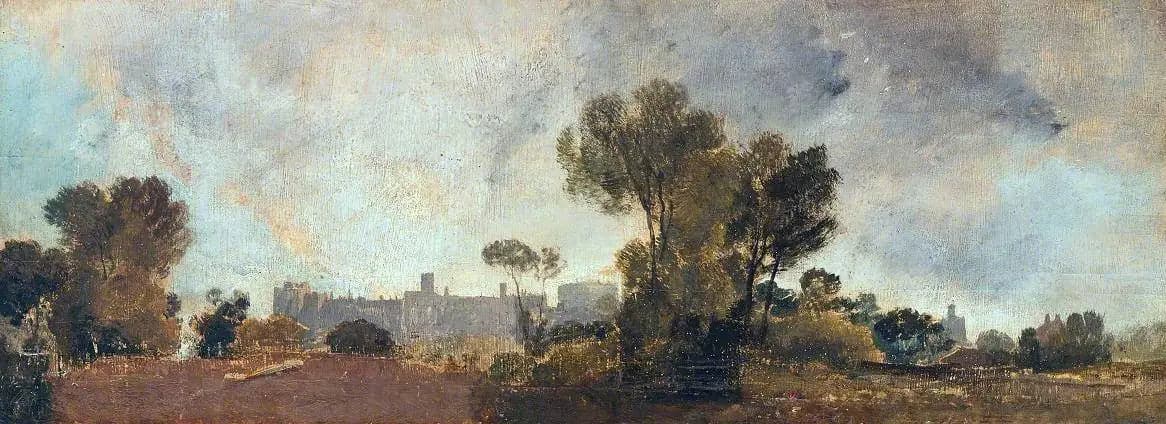
Windsor Castle from Salt Hill
- Original dimensions
- 27.6 x 73.7 cm
- Museum
- Tate
- Year
- 1807
Scene depicted
In “Windsor Castle from Salt Hill,” Turner transports us to the top of a hill, where the majesty of Windsor Castle emerges in a soft and enveloping light. The panorama reveals the beauty of the landscape, where nature elegantly blends with the historic monument, creating a delicate harmony between man and his environment. The skies illuminate with changing tones, infusing the scene with a dreamy ambiance.
Historical context
Created in 1807, the painting “Windsor Castle from Salt Hill” captures an iconic moment of the British panorama. This painting, rooted in early 19th century England, is part of the romantic movement, reflecting deep feelings and bright landscapes. Turner, then at the height of his career in London, offers viewers a dazzled look at this royal symbol, now carefully preserved at the Tate . With dimensions of 27.6 x 73.7 cm, this canvas is a true window into history.
Place in the artist's career
This painting represents a crucial step in Turner’s career, merging his emerging romantic style with a pronounced artistic maturity. Alongside other iconic paintings such as “The Fighting Temeraire” and “Rain, Steam and Speed,” “Windsor Castle from Salt Hill” reveals the fascinating evolution of his work, paying homage to light and color.
Anecdote
Turner once declared, while scrutinizing the light as he painted: “Light must be a look at the soul of things.” This quote resonates perfectly with the inspiration of his masterpiece , captured one morning when the mist slowly rises over the river, revealing the majestic castle. This fleeting moment, both mystical and tangible, accentuates the emotion that the painting evokes with such power.