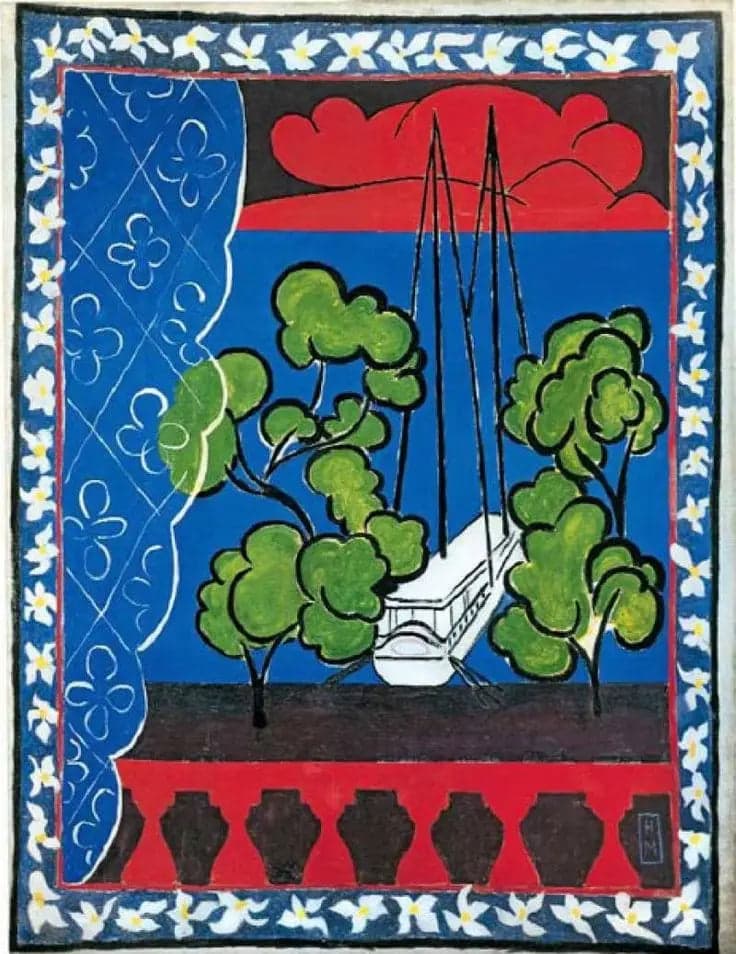
Window in Tahiti II
- Original dimensions
- 195 x 240 cm
- Museum
- Matisse Museum
- Year
- 1936
Scene depicted
This painting reveals a harmonious play between light and color, plunging the viewer into a timeless moment. The window, open to a vibrant universe, offers a glimpse of the lush garden, where shades of green mingle with bursts of light, promising a sensory journey beyond the everyday. Every element of the composition is an invitation to escape.
Historical context
Created in 1936 in Nice, this painting is emblematic of the Fauvist movement, adding to Matisse's artistic legacy a vibrant and colorful touch. At the time, Matisse explored the bright horizons of Tahiti, paying tribute to the beauty and mystery of this idyllic place. The canvas , currently exhibited at the Matisse Museum, invites immersion into a world where every hue sings the tropical light.
Place in the artist's career
At the peak of his career, Window in Tahiti II testifies to a remarkable stylistic evolution in Matisse. At the crossroads between Fauvism and a quest for purity, this work connects to other canvases , such as The Dance and The Music , where the artist further explores human emotions through pictorial expression.
Anecdote
“Art must be a joy, a celebration.” Matisse is said to have found inspiration for this canvas on a quiet morning, awakened by the scent of exotic flowers and the gentle murmur of the waves. This quote evokes the evocative power of Window in Tahiti II , captured in a fleeting moment yet eternally alive.
Major exhibitions
Matisse. Art Notebooks, the turning point of the 1930s